


SHERLOCK HOLMES & THE TORSO MURDERS
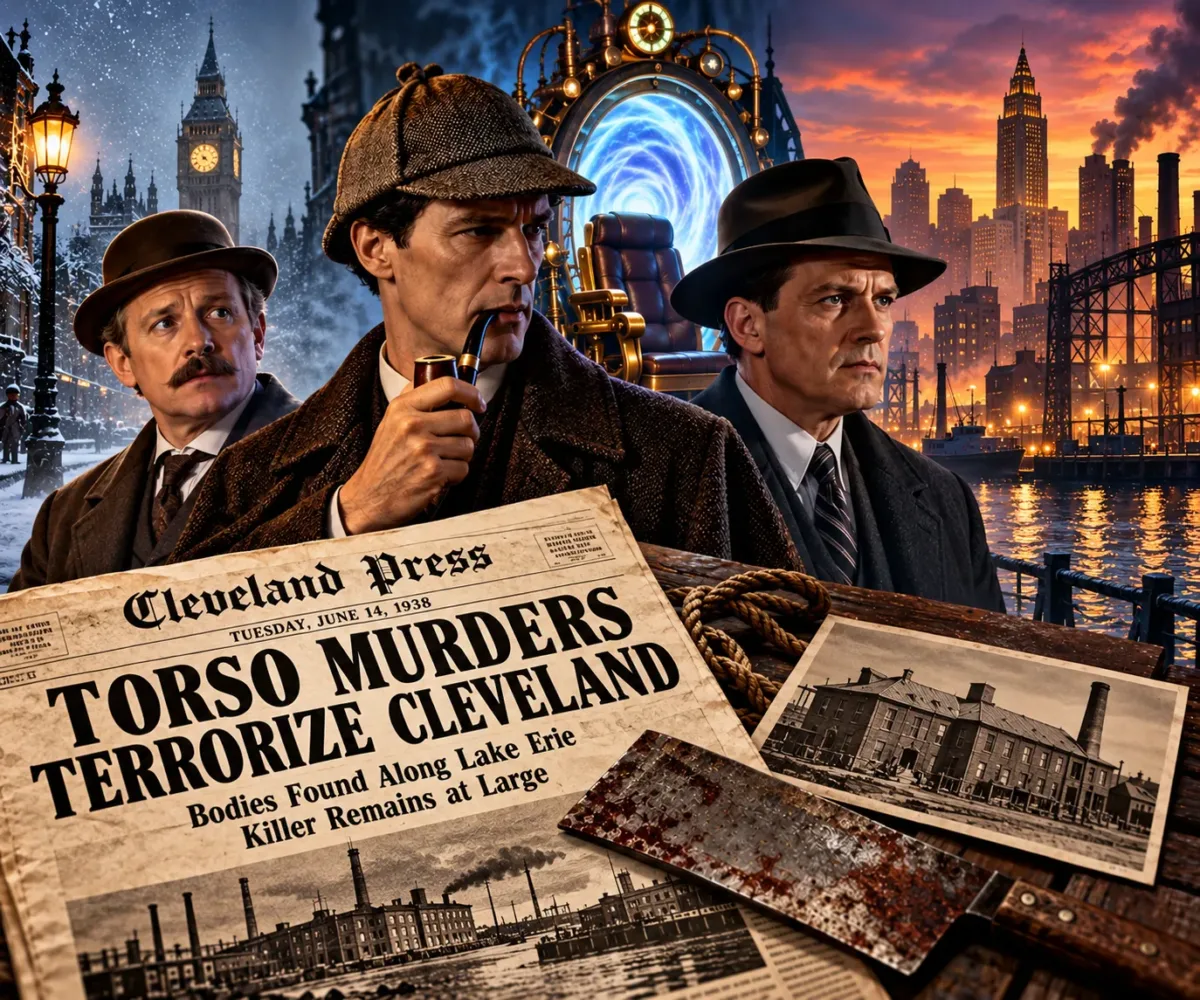
On the first Saturday of every month, various authors gathered in the back room of Ye Olde Cheshire Cheese on Fleet Street. On one particularly nasty, snowy Saturday in December 1898, the only authors brave enough to attend were H. G. Wells and myself.
Wells was still enjoying the success of his recently published novel, The Time Machine.
Rather than occupy the back room by ourselves, we found a quiet table near the rear of the establishment and ordered brandy and cheese from Ruth, who usually waited on us authors.
The establishment had been serving London’s literary community since 1667. Samuel Johnson and Charles Dickens had been frequent patrons, and even America’s Mark Twain occasionally attended our gatherings when he happened to be in London.
The dark wooden paneling and low ceilings gave one the feeling of sitting in a cave rather than a thriving London pub.
“Where’s da rest of ye?” Ruth asked.
“Yeah, where’s da rest of ye?” a shrill voice called from the corner.
“Shut up, Polly!” Ruth bellowed.
Polly was an African grey parrot that loved to horn its way into conversations, particularly by mimicking Ruth, who despised the bird.
“Ruth, fetch those two gentlemen brandy and cheese afore they change their minds,” the bird replied.
I didn’t particularly care for Polly either, the novelty having worn off several years earlier.
“I don’t think they’re coming today on account of the weather, Ruth,” I replied. “Guess you’re stuck with just me and Mr. Wells.”
“How in the world am I ta make a livin’ on jest the two of you birds?” Ruth replied cheerfully.
In truth, Ruth was probably delighted. With any luck, she’d be able to return home to her husband and eight children a little earlier.
After she departed, Wells and I resumed our conversation.
“So, Wells, I understand The Time Machine has been selling briskly. You must be delighted.”
“Aye, I am, Doc Watson. Its reception has exceeded my expectations.”
Wells always called me Doc Watson rather than Doctor or Mr. Watson. Even John would have been preferable.
“You shouldn’t be surprised. I thoroughly enjoyed it. You have quite the imagination to conceive of such a remarkable undertaking.”
Wells smiled. “Imagination might not be the proper description, Doctor.”
“What is that supposed to mean?”
“Have you ever seriously considered the possibility of time travel, Watson? Of actually visiting the past or future?”
“Certainly not.”
“Well, I have. In fact, I’ve done it.”
I stared at him.
“My Lord, are you telling me you’ve actually traveled through time?”
“Three times, Doc.”
I began to suspect Wells had lost his mind.
He explained that he’d constructed a machine capable of transporting him to almost any date or destination. He merely sat upon his machine, turned the dials, and it would transport him anywhere he wanted at any time. His first two experiments had been relatively modest, one taking him several weeks into the past and the other a week into the future.
Both had been successful, according to Wells, although his wife had been considerably less enthusiastic about his unexplained absences. Then he told me about his third journey.
“What if I told you, Doc, that I was sitting in Ford’s Theatre in Washington, D.C., the night President Abraham Lincoln was assassinated?”
“I’d say you’ve gone completely daft.”
Wells looked momentarily offended before reaching into his satchel and producing a newspaper dated April 15, 1865.
“I traveled to Washington on April fourteenth and purchased a ticket to Our American Cousin. President Lincoln arrived after the performance had begun. The audience gave him a tremendous ovation.”
“And you knew what was going to happen?”
“Of course. I knew he’d be shot before the evening was over.”
“Then why didn’t you warn somebody?”
Wells looked at me gravely.
“Because, Watson, I have no idea what might happen if I were to change history. Suppose I saved Lincoln’s life. What other events might that alter? What consequences might follow?”
I considered his explanation. He was probably right.
Then Wells removed a ticket stub from his wallet and handed it to me.
Why, I nearly fell out of my chair.
Ruth appeared with two more brandies.
“Last call, gents. Weather’s gotten so bad we’re gonna shut down early.”
“Yeah, gents, last call!” the bird repeated.
“Shut up!” Ruth shouted.
She stormed away to argue with the bird.
I examined the ticket stub carefully. Although it wasn’t absolute proof, I was beginning to believe Wells might actually have accomplished the impossible.
“Good heavens, Wells. I must tell Holmes about this.”
I arrived home shortly after six o’clock, nearly frozen. Our carriage had become stuck in the snow twice, and the driver had cursed a blue streak about anyone foolish enough to venture out in such weather.
Mary had a warm fire burning, and I stood beside it for nearly twenty minutes before asking our butler to send his son to Baker Street with a note for Holmes.
Holmes,
I have come upon a most incredible story that you’ll want to hear. Please meet me for breakfast at the coffeehouse on Marylebone Road at 7:30 tomorrow morning.
Watson
The following morning, Holmes was already seated when I arrived, drinking tea and reading The Times.
“Watson, you look as though you haven’t slept. Are you unwell?”
“Quite well, Holmes, although I confess I haven’t slept much.”
“Then tell me what’s troubling you.”
I spent the next half hour relating Wells’s extraordinary claims.
Holmes listened without interrupting.
“Well, Holmes? What do you think?”
“An extraordinary story, Watson. I’ve always believed mankind might eventually discover a means of traveling through time. I simply hadn’t expected it during our lifetimes.”
“Then you believe him?”
“I believe the possibility deserves investigation. Newspapers and theatre tickets are hardly conclusive evidence.”
“Would you like to meet Mr. Wells?”
“Indeed. And I’d very much like to examine this machine of his.”
“I’ll arrange it.”
Wells was delighted at the prospect of meeting Sherlock Holmes. We arranged to meet at Holmes’ flat at 221B Baker Street the following Tuesday morning.
After the introductions, Wells spent nearly an hour explaining his invention while Holmes examined the newspapers and ticket stub he’d brought along.
“The missus doesn’t believe a word of it,” Wells admitted. “She thinks I’m spending my time visiting pubs and taverns. When I showed her the evidence, she accused me of having it made and demanded to know how much it cost.”
“That is one of the reasons I never married, Mr. Wells,” Holmes replied. “Wives seem to concentrate on the wrong things.”
We were laughing when Mrs. Hudson knocked.
“Mr. Holmes, you have a visitor. An American gentleman named Eliot Ness. He says he’s the Public Safety Director of Cleveland and urgently needs to speak with you.”
None of us had ever heard of Eliot Ness, but Holmes agreed to receive him.
A well-dressed gentleman of about thirty-five years of age entered the sitting room and appeared surprised to find three men awaiting him.
“Mr. Holmes, I apologize for interrupting. I’ll gladly wait until your business is concluded.”
“No need, Mr. Ness. These gentlemen are my closest confidants. Allow me to introduce Dr. John Watson and the author H. G. Wells.”
Ness looked astonished.
“Well, I’ll be damned.”
“Something wrong?” Holmes asked.
“Quite the contrary. I’m familiar with Dr. Watson’s accounts of your investigations, and I certainly know Mr. Wells. In fact, his invention is the reason I’m here.”
Wells leaned forward.
“My invention?”
“Yes, sir. Your time machine.”
I nearly dropped my teacup.
Ness explained that a scientist friend in Cleveland named John Sandusky had constructed a smaller, improved version of Wells’s invention.
“I’ve traveled here from Cleveland in the year 1938,” Ness announced.
For several moments, nobody spoke.
Wells was the first to recover.
“May I see your machine, Mr. Ness?”
Ness reached into his coat pocket and produced a small black box.
“This is it.”
“Remarkable!” Wells exclaimed, examining the device. “You’ve reduced the entire vehicular apparatus to something that fits inside a pocket!”
“Please don’t change the settings,” Ness cautioned. “It’s programmed to return me to Cleveland in 1938.”
“Will it transport several people at once?” I asked.
“Anyone in physical contact with the person holding the device.”
Holmes appeared more interested in our visitor than in the invention.
“Perhaps, Mr. Ness, you should explain why you’ve sought me out.”
Ness settled into his chair.
“We have a murderer loose in Cleveland, Mr. Holmes. Somebody has been killing people, apparently at random, and dismembering their bodies. In several instances, we’ve recovered little more than the torsos.”
“Good heavens,” I muttered.
“The newspapers call him the Mad Butcher of Kingsbury Run. The murders began in 1935, and we’ve recovered the remains of twelve victims. We believe there may be others.”
“Have you identified the victims?” Holmes asked.
“Some. Most were drifters living around an area called the Hobo Jungle. Many had no permanent address, and some had nobody who even knew they were missing.”
“How have you identified those you do know?”
“Fingerprints helped identify two of the men, and dental records identified one of the women.”
Holmes leaned forward. “So fingerprint identification has advanced considerably in your era?”
“Oh, yes, Mr. Holmes. It’s one of our principal investigative tools.”
“I’ve followed Galton’s research with considerable interest. Unfortunately, Scotland Yard has been slow to appreciate its possibilities, which is how they usually go about things.”
“Well, by 1938, it’s become an important part of forensic science.”
“Forensic science?” I asked.
“The application of scientific principles to criminal investigation, Watson,” Holmes explained. “A field I expect will advance considerably in the coming decades.”
“Indeed it has,” Ness replied. “But unfortunately, none of those advances has helped us catch this bastard.”
“Have you any suspects?” Holmes asked.
“Several. One in particular is a physician named Dr. Francis Sweeney. He’s a veteran of the World War and has a serious drinking problem.”
“A World War?” I exclaimed. “My word! The entire world at war?”
“I’m afraid so, Doctor. You would be gratified to know, our side won.”
Holmes raised his hand.
“Perhaps we might leave the discussion of future wars for another occasion. What evidence do you have against this physician?”
“Nothing sufficient to bring charges. We’ve questioned thousands of people, examined the remains, and followed every lead we can find. We’ve even received postcards from someone claiming to be the murderer.”
“Postcards?” Holmes asked.
“Yes. Apparently, the killer enjoys taunting us.”
“Have you preserved them?”
“Every one.”
“Excellent. I’d like to examine those.”
Ness nodded.
“There’s something else. Similar murders may have occurred in Pittsburgh and other nearby cities, possibly dating back as far as 1921.”
“Seventeen years?” Holmes asked.
“Possibly. We haven’t established a connection.”
Holmes sat quietly for a moment.
“Tell me, Mr. Ness, why have you come to me?”
Ness smiled faintly.
“I’ve had considerable success catching criminals, Mr. Holmes, particularly during my years investigating organized crime in Chicago. But this murderer has beaten every effort we’ve made to catch him.”
He paused.
“One evening, I noticed a copy of Dr. Watson’s adventures on my bookshelf. I’d read them years earlier and remembered how often you solved cases everyone else considered hopeless.”
“And you thought of your friend’s machine?”
“Exactly. I figured if anyone could catch this fellow, it would be Sherlock Holmes.”
Holmes smiled. “Your confidence is flattering, Mr. Ness. But can you guarantee our safe return?”
“Mr. Sandusky has made numerous journeys without incident. I’ve accompanied him twice. I can’t guarantee anything, but I wouldn’t be here if I thought it was dangerous.”
Holmes rose and walked toward the window.
Outside, a light snowfall had begun.
He stood there for several moments before turning toward me.
“Well, Watson, what do you think?”
I stared at him.
“Holmes, surely you cannot be serious.”
“My dear fellow, when have you ever known me to decline an interesting case merely because the journey might prove inconvenient?”
I looked toward Wells, who was smiling broadly.
Then I looked at the small black box resting in his hands.
For the first time in my life, I found myself wishing Sherlock Holmes possessed a little less curiosity.
Holmes, Ness, and I agreed to meet back at Holmes’ flat later that afternoon for our departure to Cleveland.
I wanted to return home and inform Mary that I would be accompanying Holmes on another adventure and would write to her from our next destination. I had no intention of telling her I was traveling forty years into the future to Cleveland, Ohio, in America. She might very well have me committed.
We suggested that Wells remain in London. He was disappointed but made Ness promise to return for him once the torso murder cases had been concluded. Ness was only too happy to agree.
We departed London at four that afternoon and arrived in Ness’ Cleveland office at eight the previous morning, apparently none the worse for our journey.
I was astonished, to say the least.
I peered through his office window at the street below. Gone were the horses and carriages, replaced by automobiles crowding the streets and navigating around large trucks making deliveries. Men wore suits and fedora hats, while the ladies dressed in fashions that revealed their legs just below the knees.
Stores lined the streets, selling every imaginable product. Apothecaries were now called drugstores. I could see an electrical appliance shop displaying products Mary could only dream of: washing machines, vacuum cleaners, refrigerators, televisions, and radios. All were inventions Ness had been obliged to explain to me.
Next door was a plumbing establishment with commodes and water heaters displayed in its windows.
Naturally, Holmes noticed none of this.
He had planted himself in a chair and was poring over Ness’ files concerning the torso murders.
“Holmes, did you take any notice of the automobiles on the streets?” I asked.
He ignored my question.
“Mr. Ness, tell me what you know about this suspect named Bernie Standers.”
Ness looked at Holmes in astonishment.
“How did you know about Bernie Standers? His name has never been released to the public.”
“Not officially, Mr. Ness, but someone penciled his name into the report concerning George Dolezal. Somebody knew about him.”
“Dolezal and Standers are stepbrothers and are often seen together. Dolezal lived with one of the victims, Florence Polillo. We are attempting to put together a case against Dolezal and hope to have him in custody soon. As for Standers, he isn’t what you’d call a bright fellow, Mr. Holmes. Most people consider him a half-wit, although I’m told he’s remarkably skilled with his hands. He is heavily dependent on Dolezal.”
“Was he living with Dolezal and Miss Polillo?” asked Holmes.
“We don’t know for certain, but witnesses have told us he was frequently at Miss Polillo’s apartment. Several complained that Standers was always leering at them and making them uncomfortable. When one of the women mentioned this to Dolezal, he slapped her across the face, cursed at her, and slammed the door.”
“Leering, you say?” asked Holmes.
“That was what we were told. Whether it’s true or not, I couldn’t say.”
“What did Miss Polillo do for a living?” asked Holmes.
Having seen all the automobiles I cared to see for one day, I settled into the chair beside Holmes and began listening intently.
“Watson, have you given up sightseeing in Cleveland already?” Holmes asked.
“Well, you weren’t listening to my narrative, so I merely stopped.”
“I was listening, John, and I suspect we shall see more than our fair share of automobiles before this is over. But this Standers fellow has caught my attention.”
“In fact, Dr. Watson,” Ness interrupted, “when you gentlemen are ready to retire this evening, I’ll have one of those automobiles take you directly to your hotel. I assume you’ll be staying?”
“Yes, we shall,” replied Holmes. “I would like to visit those two stepbrothers tomorrow, if you don’t mind. I can do so incognito, as I have brought along one of my disguises. Although I suspect I shall need a more modern suit.”
“Holmes, you’re in luck. I can see a men’s clothing shop from the window.”
Holmes looked at me disdainfully.
“But first, Mr. Ness, was Miss Polillo gainfully employed?”
“She worked as a waitress and a barmaid. We believe she was also a prostitute. She had been arrested for prostitution before, which is why we had her fingerprints on file.”
“Interesting,” Holmes replied. “Then I would appreciate the opportunity to interview those two stepbrothers.”
“I can have my boys bring them in tomorrow morning and send word to your hotel when they arrive, if you like.”
“That would be splendid, Director. I look forward to it.”
Holmes rose from his chair and walked to the window.
“Now, Watson, where is that men’s shop you mentioned?”
The following morning, we made our way to Shapiro’s Men’s Store, about a stone’s throw from Ness’s office. Holmes purchased a modern blue double-breasted suit with cuffed trousers and a red tie. I had to admit it looked quite nice, until he told me he had paid fifteen dollars for it.
We returned to the hotel in a taxicab driven by a fellow who was only too happy to tell me everything about his 1937 Checker Model Y. I had merely asked what sort of automobile he was driving, and he proceeded to give me a lengthy explanation of its virtues, most of which I did not understand.
Back in our room, Holmes donned a mustache, which made him look ridiculous in my opinion, along with heavy spectacles and a blond wig. He then began smoking cigarettes, evidently a ritual nearly everybody seemed to practice in modern Cleveland.
When word arrived that the stepbrothers had been brought to the station, we took another cab, this time a Ford sedan.
I believe I enjoyed the ride in the Ford more than the Checker and remarked as much to Holmes, but he chose not to answer, being entirely focused on his new persona and the forthcoming interviews.
Upon our arrival, Ness showed me to a chair in his office and escorted Holmes to the interview room. He returned a few moments later and began telling me about Cleveland and the many advancements in society I had been witnessing.
“Mr. Ness, I don’t believe I would care to live in a world with all those automobiles belching black smoke. In fact, I think I would prefer the southbound end of a northbound horse any day.”
Ness laughed aloud at my remark, which I thought rather strange, considering I was perfectly serious.
About two hours later, Holmes returned, having completed his interviews with the stepbrothers.
“Mr. Ness, were you able to determine from the dismemberment whether the killer was right-handed or left-handed?”
“Yes. Our medical examiners concluded that the killer was most likely left-handed. But we never released that information to the public, Mr. Holmes,” Ness answered.
“Most interesting. Then I can tell you with considerable confidence that Standers is your man, and I strongly suggest you concentrate your investigation upon him. I suspect Miss Polillo may have humiliated him, perhaps by mocking his, ah…inadequacies. After years of ridicule, her murder may have given him a sense of power he had never before experienced, and one he was determined to experience again.
“Furthermore, when I remarked upon his calloused hands, I learned that Standers had once been employed as a butcher. A man accustomed to cutting through flesh and bone would possess precisely the skills required to dismember a human body.”
Holmes paused and looked directly at Ness.
“And, Mr. Ness, Standers is left-handed.”
I looked at Ness to see how he was taking Holmes’s assertion. I had witnessed Holmes arrive at the correct conclusion a hundred times and had grown accustomed to it. But I was curious to see what a man with a considerable reputation of his own, and all the advantages of modern science, thought of my friend’s deductions.
“There is one further matter, Mr. Ness,” Holmes continued.
Ness nodded. “Go on,” he said grimly.
“During our conversation, Standers mentioned an abandoned slaughterhouse where he was once employed. He spoke of its cellar with considerable familiarity, although the establishment has been closed for several years.”
“And you believe the heads might be there?”
“I believe it would be worth examining. The man has considerable skill with a butcher’s knife, is left-handed, and has an unusual attachment to a building where he once worked. Individually, these facts prove nothing. Together, they warrant investigation.”
“Well, Mr. Holmes, that certainly gives me a new direction in which to pursue the killer. We had dismissed Standers because of his limited mental capacity, but perhaps we were too hasty. I’ll send my men there immediately.”
“I advise discretion, Director. If Standers suspects you are searching for something he has concealed, he may attempt to dispose of the evidence. With the lake so close, that would be a simple matter.”
“Agreed,” Ness replied.
I could only sit there and marvel at how two men from different countries and centuries could be of one mind.
“Now, if you don’t mind,” Holmes continued, “we should like to return to our own century before Watson here decides to become a garage mechanic. Please let us know when you will be prepared to take us back.”
“Give me an hour to meet with my men and put them on Standers’ trail. Might you be able to return here by then?”
“We only need to check out and pay for our lodging,” I said.
“Your lodging, Dr. Watson, was courtesy of the Cleveland Police Department. I suggest you gentlemen take the opportunity to walk about and enjoy the sights of a major American city in the twentieth century. We’ll collect your belongings from the hotel and bring them here.”
“Thank you, Mr. Ness,” I replied, relieved that we would soon be returning to our own city and century. I was uncomfortable with this century and wanted to go back to Mary.
Holmes and I spent most of the following hour looking in the windows of the various shops. I was particularly fascinated by a washing machine displayed in the window of an electrical appliance store, while Holmes seemed content to observe the people passing along the street.
We returned to Ness’s office at the agreed-upon time. He was waiting patiently for us, apparently ready for our return journey.
We stood in a small circle while Ness adjusted the controls of his remarkable device.
“All right, gentlemen, let’s get ready. Remember, you need only keep one hand on my shoulder. Now, in three, two, one…”
At that precise moment, I felt an uncontrollable tickle in my nose.
“ACHOO!”
I instinctively raised my hand to cover my mouth.
When I looked up, Ness and Holmes had vanished.
I stood alone in Ness’s office, staring at the empty space where my companions had been only seconds earlier.
“Oh, good Lord,” I muttered.
I was still in Cleveland.
In 1938.
I gulped. A strange and frightening feeling came over me. How was I to get back to London in 1898?
I sat down to think. Then I got back up and resumed my position where I had previously been standing, hoping that merely occupying the same spot might somehow transport me back.
Nothing happened.
The fact that I had missed the journey was beginning to settle upon me. I was alone in Cleveland, Ohio, in the year 1938, some forty years removed from everything and everyone I knew.
Then it occurred to me that all I had to do was wait until Ness returned, and he could take me back. I felt considerably better with this realization.
Suddenly, the office door opened and a young woman entered.
“May I help you, sir?”
“Indeed, madam, I sincerely hope you can. I am Dr. John Watson, and I must speak with Mr. Ness immediately.”
“Mr. Ness has gone out, sir. May I ask how you got into his office?”
“That, my dear lady, is a rather complicated matter.”
She regarded me skeptically.
“Perhaps you had better explain, sir.”
What was I to say? I found myself stranded in another century, in another country. I felt helpless, surrounded by people who spoke my language but whose customs were entirely foreign to me. Surely the truth, however improbable, was preferable to a lie.
“Madam,” I began carefully, “I have just arrived from London in the year 1898, and through a most unfortunate accident, I have been left behind.”
She looked at me as if I had lost my mind.
“Sir, please have a seat, and I’ll get somebody to help you.”
She left for a few minutes and then returned with two uniformed police officers. One of them approached me.
“Who might you be?” he asked.
“Dr. John Watson, from London,” I replied.
“Have you got any identification, sir?”
I dug around in my wallet and produced my medical credentials. He read them carefully and then showed them to the other officer.
“How old are you, sir?” he asked.
I thought that was an odd question.
“Forty-five, my good man. Why do you ask?”
“Sir, this says you qualified as a doctor in London in 1878, sixty years ago. The math doesn’t add up. Have you been drinking?”
“Why, no, officer. A strange question for you to ask, if you don’t mind my saying.”
“I think we’ve heard enough. Sir, I’m afraid you’re going to have to leave the premises. Come with us.”
I did as they said. They led me out to the street and instructed me not to enter the building again.
I started to protest, but they merely shut the door in my face.
I stood there for a few moments, dumbfounded. I had never been treated so rudely since my time in Afghanistan. I had to get back into Ness’s office and wait for him to return.
I opened the door and went back inside, where I was immediately confronted by a very large policeman.
“You were told to leave, sir. Now, either do as you’re told or we’ll lock you up.”
“I need to see Director Ness!” I practically screamed.
“That won’t be possible, sir. Either leave now or I’ll arrest you.”
Having no desire to be incarcerated, I left.
I walked up and down the street, considering what I should do next.
Then it occurred to me that I had no money and only my medical credentials to identify myself. I had no way of feeding myself or finding lodging for the evening.
When Holmes and Ness arrived back at 221B Baker Street, the first thing they noticed, of course, was that I was not with them. What I am about to relate to my dear readers was told to me later by Holmes, between bouts of laughter, the likes of which I had never witnessed from him.
“Mr. Ness, it appears that, for whatever reason, Dr. Watson did not accompany us back to London in 1898.”
“Yes,” Ness said dejectedly. “I wondered when he sneezed whether he had let go of us and therefore was not transported with us.”
“Then we must go back at once and get him,” Holmes said.
“I’m afraid that isn’t possible right away, Mr. Holmes. The machine has to recharge itself for nearly twelve hours before it will transport us again.”
“Twelve hours! Mr. Ness, Watson will be a basket case if we cannot fetch him immediately.”
“I’m sorry, Mr. Holmes. It’s simply a characteristic of the machine.”
“Very well, then. We must leave as soon as the machine has properly recharged. I can only hope that my doctor friend can remain calm while he waits for us.”
“While we wait, Mr. Holmes, would you show me what life was like here in London in 1898? You see, this is five years before I was born, and I would be very interested in seeing the London of your century.”
Holmes agreed, although he later confessed that he spent much of their excursion wondering what trouble I might have gotten myself into.
Meanwhile, back in Cleveland, I was standing across the street from Ness’s office, watching to see whether anyone I recognized might leave the building.
Just then, I heard a commotion farther down the block. I turned and saw a crowd gathering in the street. An automobile had struck a pedestrian, and a man lay on the pavement, bleeding, while the driver stood over him cursing.
I hurried toward them.
“Excuse me,” I said, pushing my way through the crowd. “I’m a doctor.”
I knelt beside the injured man and began assessing his condition. He had suffered a nasty wound to his leg, and blood was flowing freely onto the pavement.
I had scarcely begun applying pressure to the wound when the police arrived. To my dismay, one of them was the same officer who had escorted me out of Ness’s office.
“Hey, bub, what do you think you’re doing?” he demanded.
I looked up at him incredulously.
“What do you think I’m doing, sir? I’m attending to this poor man!”
“Back off, mister. You ain’t licensed to practice medicine in this state.”
“I beg your pardon! The man is bleeding to death. Would you prefer I stand here and watch?”
“That’s enough out of you. Get up.”
“Officer, if I release this wound, he may bleed to death!”
Another bystander stepped forward and offered to hold the cloth against the man’s leg. I showed him where to apply pressure.
“Keep your hand there,” I instructed. “And don’t let up until the ambulance arrives.”
The policeman seized my arm.
“Now you’re coming with me.”
“On what grounds?”
“Disorderly conduct, trespassing earlier, and refusing a police officer’s instructions. Take your pick.”
Before I could protest further, he produced a pair of handcuffs and fastened them around my wrists.
I was furious. I had spent years attending wounded soldiers and sick patients, and now I was being arrested for attempting to save a man’s life.
“You have to keep pressure on that wound!” I called over my shoulder.
“Shut up,” the officer replied. “One more peep out of you and I’ll show you the business end of my nightstick.”
It was then that a rather comforting thought occurred to me.
At least in jail I would be fed and have a place to sleep for the evening.
I said no more.
Fortunately, an ambulance arrived, and two attendants took charge of the injured man.
An hour later, I found myself in a small holding cell in the basement of City Hall, the very building in which Ness maintained his office. Apparently, a few cells were kept there for prisoners awaiting questioning or transfer to the main police station.
I had never been so pleased to be inside a building.
Now all I had to do was get word to Ness.
While they were booking me, I asked the officer on duty to please leave a message for Director Ness, explaining that Dr. John Watson was being held downstairs and would appreciate a word with him.
The officer looked at me as though I were mad but promised to pass along the message.
The cell was filthy. My only companion was a rat that scurried across the floor. A man in the next cell moaned incessantly, occasionally shouting something I could not understand.
Two hours passed without word from Ness.
I finally stretched out on the narrow bunk, wondering what Mary would think if she knew her husband was spending the night in an American jail forty years in the future.
Within minutes, I was sound asleep.
“Watson, wake up!”
I opened my eyes and looked up into Holmes’s face. For a moment I thought I was dreaming, until he shook me again.
“Watson, it’s me, Sherlock.”
I sat upright.
“Holmes! Where have you been?”
“Well, Watson, I’ve been to London and back.”
My eyes adjusted to the dim light. Holmes stood before me with an enormous smile on his face. Behind him was Director Ness and my friend HG Wells.
“I must say, Watson, of all the inconveniences you’ve subjected me to over the years, this must rank among the most exceptional. Why didn’t you accompany us back to London?”
“I sneezed at the very moment you gentlemen were leaving and put my hand over my mouth.”
“Really, Watson? A sneeze?”
“It’s the only explanation I can offer.”
Holmes began laughing again. I did not find the matter nearly as amusing.
“Dr. Watson, please accept my humblest apologies,” Ness said. “I’ve had words with the officer who arrested you. Let’s get you out of here and have some breakfast at the diner down the street. My treat.”
I was famished, having eaten nothing since the previous afternoon, and heartily agreed.
We went directly to the diner and ordered breakfast. While we ate, Holmes explained what had happened in London and why their return had been delayed.
Then he informed me that we would have to wait another twelve hours before we could travel back to 1898.
I was crestfallen.
“Another twelve hours?” I exclaimed.
“I’m afraid so, Watson. It seems Mr. Ness’s remarkable machine requires a considerable amount of rest between journeys.”
“Rather like yourself, Holmes, although I have seldom known you to take it.”
He smiled.
“I have some work to catch up on, and I want an update on Standers,” Ness said as we were leaving the diner. “You gentlemen are free to do whatever you like today. Meet me back at my office around six o’clock tonight.”
“That would be splendid, Director Ness,” Holmes replied. “I was wondering whether you might have time to show us the Cleveland Police Headquarters. I should very much like to see the present-day methods of scientific investigation.”
“As it happens, Mr. Holmes, I’ll be at headquarters around four o’clock this afternoon. If you arrive at four-thirty, I’ll have time to show you whatever you’d like to see. Our scientific equipment is state-of-the-art, and I think you’ll be impressed.”
“Then we shall be there precisely at four-thirty, sir.”
I listened to their conversation, although I was not particularly interested in Holmes’s opportunity to inspect another police department. I simply wanted to return home and explain to Mary that I had spent the night in a jail cell.
Then I remembered that it was 1938, not 1898.
I still hadn’t decided what I was going to tell her about time travel. I might even consult Holmes on the matter.
“Dr. Watson,” Ness continued, “you might be interested in seeing a few other places that didn’t exist in your day. I’d start with the Terminal Tower at Public Square.”
“What’s that?” I asked.
“A fifty-two-story skyscraper. There’s an observation deck on the forty-second floor.”
“Did you say forty-two floors?”
“Yes, sir. And you can reach it by elevator. No climbing stairs.”
“I think we should make that our first stop, Watson,” Holmes said.
“Indeed,” I replied.
For the first time that morning, I was beginning to feel a little better about being stuck in Cleveland.
Ness gave us a few other suggestions, and we set out for the tower.
When our cab dropped us at Public Square, we stood outside looking upward in astonishment.
Never had we seen a building so high. I craned my neck until it began to ache.
“Good heavens, Holmes! Look at the size of that thing!”
“Quite remarkable, Watson. Fifty-two stories, you say?”
“So Mr. Ness tells us. Why, it must be nearly twice the height of St. Paul’s Cathedral!”
Holmes said nothing. He was studying the building with an expression of genuine admiration.
We entered through the great doors and found ourselves in a bustling concourse filled with travelers. There were ticket counters, shops, restaurants, and people hurrying in every direction.
I soon discovered that the building stood above a railway terminal.
“Holmes, there’s a railroad station underneath us!”
“Indeed, Watson. And a most impressive one, from what I can see.”
We descended to the terminal level, where passengers hurried toward their trains. Holmes was particularly interested in the electric locomotives that hauled the trains through the underground approaches.
“Extraordinary,” he said. “No smoke or steam beneath the buildings. A sensible arrangement.”
“Good heavens, Holmes, they’ve constructed a city above a railway station!”
“An admirable use of space, Watson.”
After satisfying Holmes’s curiosity about the railway, we returned to the main floor and found the elevators leading to the observation deck.
I was familiar with lifts, of course, but nothing in London had prepared me for an ascent of forty-two floors.
The elevator rose at a speed that made my stomach feel decidedly uncomfortable.
“Are you quite well, Watson?” Holmes asked.
“Perfectly, Holmes. Although I should be considerably happier if this contraption were attached to the ground.”
“It is attached to the ground, Watson.”
“You know perfectly well what I mean.”
He smiled.
When we finally reached the forty-second floor, we stepped through a foyer and onto the observation deck.
The view was incredible.
To the north stretched Lake Erie, an enormous body of water that seemed to disappear into the horizon. Factories lined the shoreline, their smokestacks pouring black clouds into the sky. Below us, automobiles moved through the streets like tiny mechanical insects.
I happened to look straight down. Vertigo came upon me immediately. I grabbed the railing and then made my way to a nearby bench.
Holmes, meanwhile, appeared entirely unaffected by the height. He was studying the railway yards below with great interest.
“Look at the arrangement of those tracks, Watson. Quite ingenious.”
I looked briefly in the direction he indicated and then turned my attention elsewhere.
“Holmes, I have no desire to look down again.”
He laughed. “The twentieth century appears to be a remarkable time to live, Watson.”
“I’m not so sure of that, Holmes. Everything seems too busy for my liking. It’s as though the whole world has gotten itself into too damned much of a hurry.”
“Progress, Watson.”
“Perhaps. But I cannot imagine why anybody would need to be in such a hurry all the time.”
Holmes leaned against the railing, smiling.
“Then you should be grateful, my dear fellow, that we have the means of returning to a more leisurely century.”
“I shall be considerably more grateful when we actually do.”
We spent the next several hours exploring Cleveland. We visited the Cleveland Museum of Art, where Holmes examined several paintings with considerable interest, and drove past Severance Hall, which Ness had told us was the home of the Cleveland Orchestra.
Holmes was disappointed that we would not have an opportunity to attend a concert. We also passed through the grounds of Western Reserve University, although by that time I was growing weary of sightseeing.
Holmes had expressed an interest in visiting Kingsbury Run, where several of the torso murder victims had been discovered, but Ness had warned us that much of the shantytown had been cleared and burned during the recent police operation.
I was perfectly content to leave the place alone.
At precisely four-thirty, we arrived at Cleveland Police Headquarters, where Ness was waiting.
He escorted us through the building, introducing us to several officers responsible for criminal investigations.
Holmes was particularly interested in the fingerprint department. He examined their equipment, questioned the men about their methods, and spent nearly an hour discussing the comparison and classification of fingerprints.
I found the subject considerably less fascinating.
After all, I had already spent the better part of a day in the custody of Cleveland’s finest, and I had no particular desire to become better acquainted with them.
Ness also showed us the police communications equipment and explained how patrol cars could receive instructions by radio.
Holmes was impressed.
“An extraordinary advancement, Director Ness. The ability to communicate with officers while they are moving about the city must be of tremendous value.”
“It certainly is, Mr. Holmes. Although we still have plenty of problems to solve.”
“Indeed,” Holmes replied. “I suspect the criminal mind has advanced along with your technology.”
By the time we returned to Ness’s office at City Hall, it was approaching six o’clock.
“You gentlemen want to have a bite to eat before going back to London,” Ness asked, “or are you anxious to get home?”
At the very moment I announced that I wished to return immediately, Holmes was agreeing to dinner.
He looked at me.
I looked back at him.
“On second thought, Director Ness,” Holmes said, “I believe Watson has had quite enough of the twentieth century.”
“Quite enough, indeed,” I replied.
Ness smiled.
We stood together in his office, and this time I made certain that I had a firm grip on his shoulder.
“Ready, gentlemen?” he asked.
“More than ready,” I replied.
Ness adjusted the controls.
“Three, two, one…”
I closed my eyes.
A moment later, we were standing in Holmes’s sitting room at 221B Baker Street.
I looked around in relief.
The familiar fireplace, the cluttered mantelpiece, Holmes’s books and papers, and the comfortable old chairs had never appeared so inviting.
“Home at last,” I said.
“And without a sneeze this time, Watson,” Holmes replied.
I ignored him.
As Ness could not return to Cleveland until the following morning, Holmes arranged for him to stay in a spare room at Mrs. Hudson’s lodging house.
Holmes suggested that the three of us dine together, but I begged off, explaining that I wanted nothing more than to return home to Mary.
I took a hansom cab to my house, where Mary had just sat down for supper.
She asked the maid to set another place, and we settled into the parlour while my meal was being prepared.
“Mary, my love, I cannot tell you how wonderful it is to be home. Have you had any difficulties while I was away?”
“Nothing more than usual, John. But never mind that. Tell me about your trip with Holmes.”
I looked at my wife for a long moment.
Where on earth was I to begin?