

ENOCH ASHLEY’S LAST SONG
Greg Baldry was sixteen when the band Frigid Pink released the classic song, House of the Rising Sun. He heard it on a jukebox in a local malt shop in the small Midwestern town he lived in.
He was mesmerized by guitarist Gary Thompson’s distorted guitar licks with fuzz and wah-wah effects. Nobody Greg had ever heard played guitar that way. He also liked the opening lyrics, hauntedly sung.
“There is a house in New Orleans
They call the Rising Sun…”
Lyrics to songs were not readily available then. In 1969 there was no internet. Greg learned songs the hard way by dropping the needle on the record, stopping it every few notes, then teaching himself each phrase by ear.
When he finally came up with the lyrics, he mistakenly thought the song was about a man talking about prison. It would be years before he learned it was actually about a brothel in New Orleans.
He wrote to a disc jockey at WLS in Chicago to see if they could give him any information. He was disappointed to learn nobody knew who wrote the song or even when it was first recorded. They really didn’t know much about the band Frigid Pink, as it was their only hit. Larry, the DJ did say he would look into it to see if he could find anything else.
Greg had started a garage band, like everyone else of his day, and played the record for his band-mates. They were blown away by the song. Then he surprised them by playing the opening chords he had taught himself. They were complimentary, but without the proper equipment, they realized he wasn’t really capturing the sound of Frigid Pink.
His band, The Baldry Brothers with Tim on bass, his brother Donny on drums, and Tracy on vocals and the organ, decided it would be a great addition to their small repertoire of songs. If they could come close to that sound, they would even chip in and buy the equipment, used of course, that Greg needed.
When they played Rising Sun at the wedding of Tracy’s older brother, the song went over like a lead balloon. Nobody danced. The bride cried about it.
Still they persisted. At their next gig, a high school performance, they played the song again. This time, the crowd buzzed and asked them to play it as an encore. They didn’t dance either but cheered them on. One gal asked for Greg’s autograph.
They bought the equipment Greg needed and let him rip with it. In no time, Greg had the licks down and was coming close to the Frigid Pink sound.
One night, while practicing, Greg heard applause. He looked around the garage, even walking around the outside, but found nobody. He was sure he heard applause though.
The next day the band decided to take a chance by renting an old coliseum used mainly for wedding receptions. They put posters out announcing their show.
A couple nights before the concert, Greg sat in the family garage, practicing the song. At last, he thought he had it nailed. When the last chord faded, he heard applause again.
After school on Friday, he was back in the garage late into the night practicing. It sounded even better than the night before. He’d mastered the fuzz. When he was done, he swore he heard someone singing the last refrain.
Saturday morning, the day of the show, Greg received a call from Larry, the DJ at WLS. Larry told him he had found a little information about the song. It was first recorded by a man named Tom Ashley in 1933. Tom maintained the song was written by his grandfather, Enoch, around the time of the Civil War. Nobody could ever prove it one way or the other.
Greg did the math in his head. If Larry was right, he had been trying to master a song that had survived more than a century.
That night, the concert was a huge success. Kids crowded the stage to get autographs or to take Polaroid pictures of themselves with the Baldry Brothers. They screamed for them to play The House again, which they gleefully repeated. The owner of the coliseum told them to come back the next night, which they gladly accepted.
After the show, the band members were packing up their gear and loading it into Greg’s dad’s van. He had just put his guitar case in the van when he heard someone.
“You’re not supposed to be able to play that one chord progression. Nobody’s done it since my grandson did it.”
Greg looked behind him and there was an old man standing there.
“You talking to me?” Greg asked.
“Ain’t no one else around, is there?”
Greg jumped out of the van to face the stranger. He studied him closely as he was having a hard time comprehending the man. The first thing he noticed was the man wore a Confederate soldiers gray uniform. It was dirty, torn, and tattered.
‘Was that a bullet hole?’ he wondered.
“You in one of the Civil War enactment groups?” Greg asked.
“Huh?” the man replied.
Greg took that response as a no.
“Who are you?” Greg asked.
“Name’s Ashley. Enoch Ashley. Though I reckon most folks quit saying it about a hunnert years ago. Boy, I’ll tell you again. You’re not supposed to know that progression. I only taught it to my grandson, Tom.”
Greg snorted, “which progression is that?”
Enoch ignored the question.
“With the exception of that garbage you introduced the song with, I have to say you done a mighty fine job with my song.”
“Garbage? Your song?”
Enoch spit on the ground.
“That noisy electric contraption. Songs ought to breathe, not holler.”
Greg was startled. “You said it was your song?”
“That’s right. My song. I wrote that song for my wife.”
“Who was she? Did she ever hear it?” Greg asked.
Enoch smiled.
“Every evenin’. I’d play it on the porch while she shelled peas.”
Then…
“She died before the war ended.”
Enoch looked away. Then quietly said…
“Best woman God ever put on this earth.”
“Come on, did Larry at WLS send you here?”
“Who?”
“So, you’re telling me I’m standing here talking to a man well past his 100th birthday, you’re not an actor, and you wrote a song that nobody knows who wrote. Have I got that right?”
“I reckon that pretty much sums it up.”
“And I’m supposed to believe that?”
“I reckon that’s up to you, sonny.”
Greg reached out to grab Enoch’s arm, but his hand passed right through it. He tried again with the same results.
“What the hell! You ain’t even real,” Greg cried.
“If I ain’t real, then who you talkin’ to, you young whippersnapper?”
He had a point, Greg thought.
“Prove you’re real, then.” Greg shouted.
With that the ballcap he was wearing blew off his head. Greg blinked.
“What ya want with me, then?”
“I want to know where ya learnt that guitar progression – the one that skips a note. I only taught it to my grandson, Tom. Everybody I’ve heard play it in all these years never picked it up either.”
“Nobody. I just picked it up during hours of practice. It became a bridge to the next progression. I don’t think I could play it without that progression now.”
“Well you done good, you have.”
“Does that mean you will leave me alone now?”
“Possibly, but I ain’t making no promises.”
With that Enoch disappeared.
Greg picked up his hat and climbed back into the van to wait for the rest of the guys. He played the chord progression but found himself now unable to skip that one note, which made him late to the next chord. The more he tried to do it, the messier the piece became.
Completely perplexed, he gave up and went home with the rest of the band.
The following morning, he went straight to the garage. He picked up his guitar and started to play the chord but was still unable to pick it up. He slammed his fist against the workbench and screamed in frustration.
‘Was that damn ghost playing tricks on him, he wondered.’
During the course of the day he tried it a few more times without luck. He was getting frustrated. He said nothing to his band-mates about the visitor from the night before, or his sudden inability to master the song.
He was nervous as he walked on stage. The band went through the set list with ease, but the anticipation had tied a knot in his stomach.
Finally, it was time for the encore – The House – as the band called it. Greg soared through the opening chords with no problem, using his newfound skills with the fuzz and wah-wah effects. The crowd cheered.
He was nearing the chord progression, the one he lost the ability to play. He turned his back to the audience to make sure they didn’t see him make the mistake.
When it came time to hit that chord, he did so flawlessly. He closed his eyes, relieved that the skill came back to him. For reasons he didn’t understand he looked up and mouthed a thank you to Enoch.
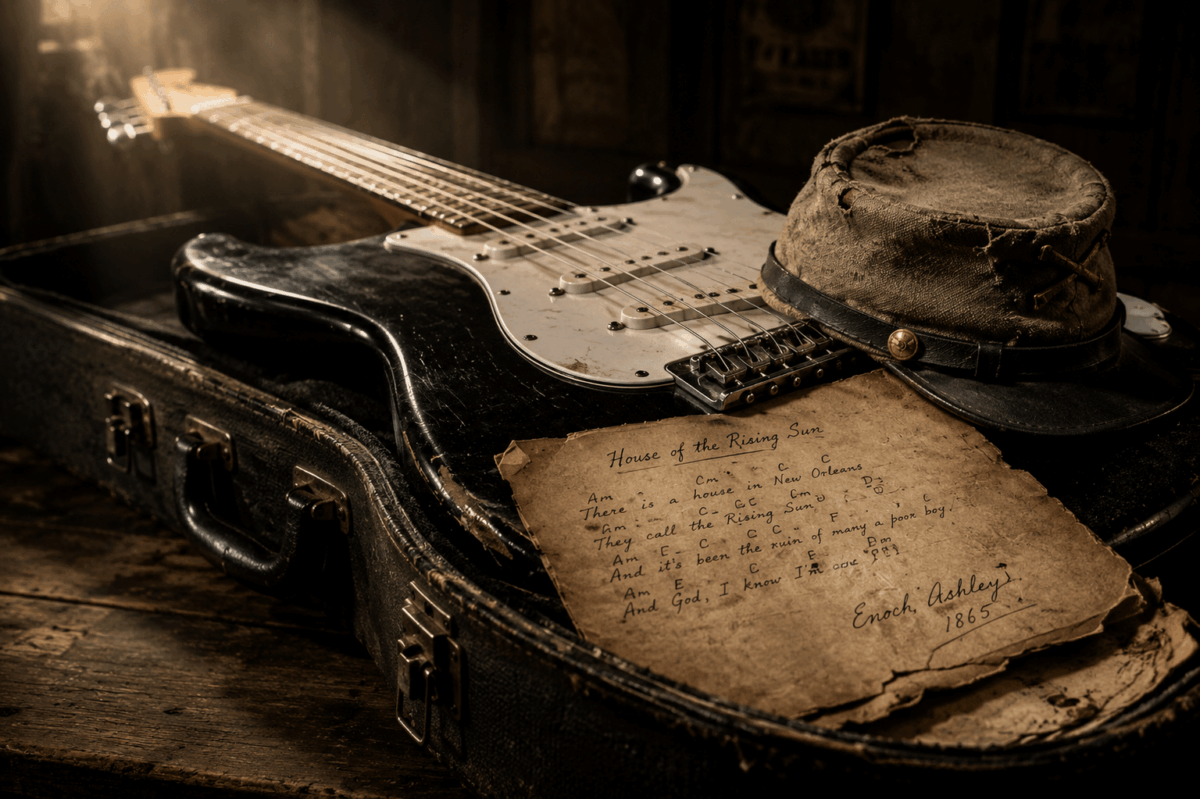
After the show, Greg picked up his guitar to put it in its case. It was then he noticed a Confederate cap and a folded piece of paper inside it. The paper was old, yellowed, and rough hewn.
He carefully unfolded the paper to read it, which was hard to do in the writer’s coarse, thick scribble. It took a moment to figure it out. The memo contained the lyrics written for House of the Rising Sun with the guitar chords penciled below it. It bore the signature of Enoch Ashley and dated 1865.
He looked the chords over carefully and played them on his guitar. Sure enough, the hidden guitar progression was right there when someone was actually playing the song.
Greg spent years trying to authenticate the manuscript. No historian believed him. Music experts insisted the paper was genuine but could never explain how a document dated 1865 contained a song that wouldn’t become famous for another century.
Greg eventually stopped trying to convince anyone. He framed the pages and hung them above the guitar that had introduced him to Enoch Ashley.
Some nights, when the garage grew quiet enough…
he could still hear applause.
AUTHORS NOTE
Tom Ashley really did record House of the Rising Sun in 1933 and credited the song to his grandfather, Enoch Ashley. Historians have never been able to prove whether that claim was true. Frigid Pink released its celebrated version in 1969.