


A SPACE IN TIME – CHAPTER 9
Chapter 9
After visiting Seward, the President and Stanton spoke quietly during the carriage ride back to the White House. Lamon rode ahead on horseback, alert for anyone foolish enough to take another shot at the president.
“Mr. Seward is extremely fortunate to have survived, Edwin,” Lincoln said.
“Yes,” Stanton replied. “Yes, he is, Mr. President.”
“While you were speaking with Mrs. Seward, the doctor told me privately that Mr. Seward faces an uphill battle. His condition is not grave, but it is serious.”
“I expected as much, sir.”
A brief silence settled between them, broken only by the steady clopping of the horses.
“I believe I am going to take your advice and spend the rest of the day with my sons,” Lincoln said.
“That would be the best decision you’ve made today,” Stanton replied. “You need rest. Then, assuming you won’t take our advice and remain away for a few more days, tomorrow we can broach Reconstruction.”
“Yes, Edwin. They failed to kill me, but they have not failed entirely in their purpose. What they truly hoped to kill was what comes next.”
“I agree, sir, but let’s discuss that tomorrow. For the rest of today, put it from your mind and tend to your family.”
When Burke delivered the President back to the White House, Lincoln stepped down from the carriage.
“I won’t be needing you for the rest of the day, Burke. Probably not tomorrow either.”
“Very well, Mr. President.”
Burke tipped his hat and drove off to put the carriage away.
As Lincoln and Lamon made their way up the steps, a man who had been sitting on the stoop rose quickly, hat in hand. The moment he approached, Lamon moved in front of him and nearly knocked him backward.
“The President is not seeing guests today,” Lamon barked.
“Mr. President,” the man pleaded. “Mr. President, I mean you no harm. May I speak with you, sir? It’s about my farm.”
“I said—”
Lincoln raised a hand, cutting Lamon off.
“I’ll hear what he has to say, Lamon, but thank you.”
Lincoln turned back around to the man, who now had his hat in his hand.
“What is it you wish to discuss my good man?”
“My name is John Jones. I have a small farm down in Dale City. There are still troops occupyin’ my farm, Mr. President,” the man said. “They make vulgar remarks to my daughters and eat our food. We’ve been forced to sleep in the barn. I did not mind much while the war was being fought, but the war is over now. Isn’t it time for them to leave. Please, Mr. President. I beg you. Have the troops removed.”
Lincoln looked at the man, then at Lamon. His expression darkened. It was not merely a complaint. It was a reasonable plea from a man who had endured enough.
“Sir, I will speak with General Grant today and have the matter addressed. Unless there is a specific military reason for those men to remain, they will be removed forthwith. You have my apology for what you and your family have suffered.”
“Thank you, Mr. President. Thank you so much.”
The farmer shook the president’s hand, turned and hurried away without looking back.
When he was out of earshot, Lincoln spoke quietly to Lamon.
“See to it those troops are removed today, Lamon. Also, send a crew tomorrow to repair whatever damage has been done to that man’s property. And I would like a word with the officer responsible.”
“Yes, sir,” Lamon said.
They entered the White House together. Lamon went directly to his office, while Lincoln made his way to the family quarters.
Inside, Lincoln found Mary, Robert, and Tad in the parlor.
“Abraham,” Mary cried, rising from her seat. “What are you doing home?”
“Well, my dear, you wanted me home, and so here I am.”
Robert put his law book down and stood from the davenport and embraced his father.
“Father, we are elated to see you.”
“My son,” Lincoln said, holding him a moment longer, “it appears I have been granted additional time, and I intend not to waste it.”
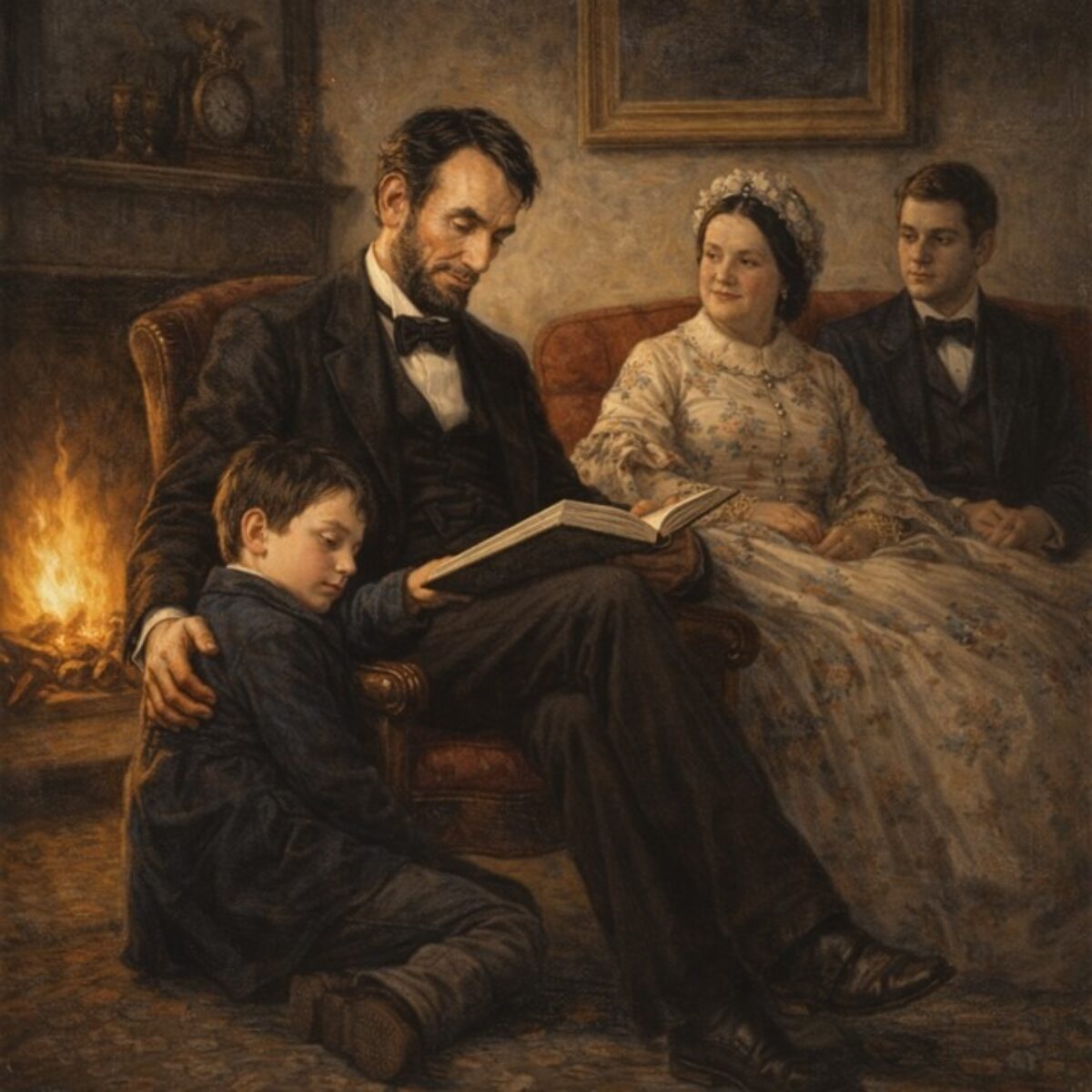
Lincoln removed his jacket and handed it to one of the staff before settling into his chair. Tad climbed onto his father’s lap. Usually a lively boy, he said nothing. He only rested against him, wanting to be close.
The four Lincolns spent the rest of the afternoon in the parlor. The President told them of Seward’s condition, but the assassination attempt itself was not discussed. They had an early dinner in the White House dining room, then returned to the parlor.
Lincoln settled into a chair beside the fire and put on his glasses. That evening, he
intended to read from *Arabian Nights*, one of his favorites. Tad sat at his father’s feet, chin in his hands, still strangely quiet, but waiting patiently.
Mary and Robert sat together on the davenport. Both had carried their wine glasses in from dinner.
“Well, Tad,” Lincoln said, looking down at his youngest son, “you’ve been unusually quiet today. Cat got your tongue?”
Tad looked at his father and burst out bawling. “They tried to kill you, Papa. I’m afraid.”
“I know you are, Tad. Truth be told, I was frightened myself for a moment. But fear only wins if we let it. We must continue living our lives, son, even when bad men try to make us do otherwise.”
“He’s right Abraham!” Mary added in crossly.
“Now, now, my family, don’t fret so. Mr. Seward has assigned additional troops to protect me. There is a manhunt going on as we speak that is tracking down Mr. Booth. I’m probably safer now than at any time during the war.”
The room got quiet. After a few moments, Lincoln playfully poked Tad in the ribs.
“Let’s continue with our book, my dear family. Tonight we shall travel east, farther than any railroad yet dares.”
He opened the book and began.
“And the merchant set forth at dawn, crossing deserts where the sand shimmered like a golden sea, until he came upon a garden hidden behind walls of white stone. Within that garden grew a tree unlike any other, whose branches bore fruit of emerald and ruby, and whose shade was cool as mercy.
“The merchant, though weary from his travels, marveled at the sight, for he knew that not all treasures are meant to be seized. Some are meant only to be witnessed.”
Lincoln looked over the top of the book at Tad.
“Did you hear that, Tad? Not all treasures are meant to be seized. That, my son, is true wisdom.”
Mary sat quietly nearby, listening more to the steady cadence of her husband’s voice than to the story itself. It was the same voice that had steadied a fractured nation, but now it conjured distant gardens and jeweled trees. She reminded herself how close they had come to losing him the night before, and shivered. She could not imagine life without him. More than anything, she looked forward to leaving Washington and returning home to Kentucky with her entire family intact.
Before resuming, Lincoln looked over at her. It was almost as if he had read her thoughts. Their eyes locked.
After a few moments, Lincoln continued.
“So the merchant rested beneath the jeweled branches and gave thanks, content in the knowledge that even in the widest deserts, Providence sometimes plants a garden.”
By nine o’clock, Mary helped Tad to bed, though not before the boy embraced his father for a long while. Once Tad was settled, Mary retired as well.
For the next two hours, Robert and his father talked alone.
“Father, do you believe a man learns more from a law school or from practicing under a good attorney?” Robert asked.
The question surprised Lincoln. He smiled sardonically.
“Considering I never attended one, I suppose you know my answer.”
Robert smiled. “I guess I should have known that. Another question, if you don’t mind.”
“Robert, you are my eldest son, of my flesh and blood. You should always feel free to ask me anything. I assure you, my son, I never mind hearing what you have to say.”
“Thank you father. What is your opinion of entering politics, then?”
Lincoln smiled again. Robert noticed, thinking how wonderful it was that his father was smiling, something they hadn’t seen since the damn war started.
“Son, it is my opinion, since you asked, that you would do well to practice law for a time. And, after some years in that profession, if you still haven’t come to your senses, then by all means, try your hand in politics.”
Robert chuckled. “You always have a great way to drive home a point. I only wish I had that ability.”
“I take it you caught my meaning then. If I had to do it all over again, especially knowing what I now know, I’d still be back in Springfield defending clients over the rights to a pig.”
Now Robert laughed. It felt so good to be having a conversation with his father. Then he turned serious.
“What are your plans for Reconstruction?”
For the next hour they discussed his plan but remarked he would seek the council of those that are more versed in laying out a proper plan. He knew what he hoped for. He knew what he feared. But as for what would actually happen, even Abraham Lincoln could not yet say.