

THE LIBRARY OF UNWRITTEN BOOKS
July 2, 1961
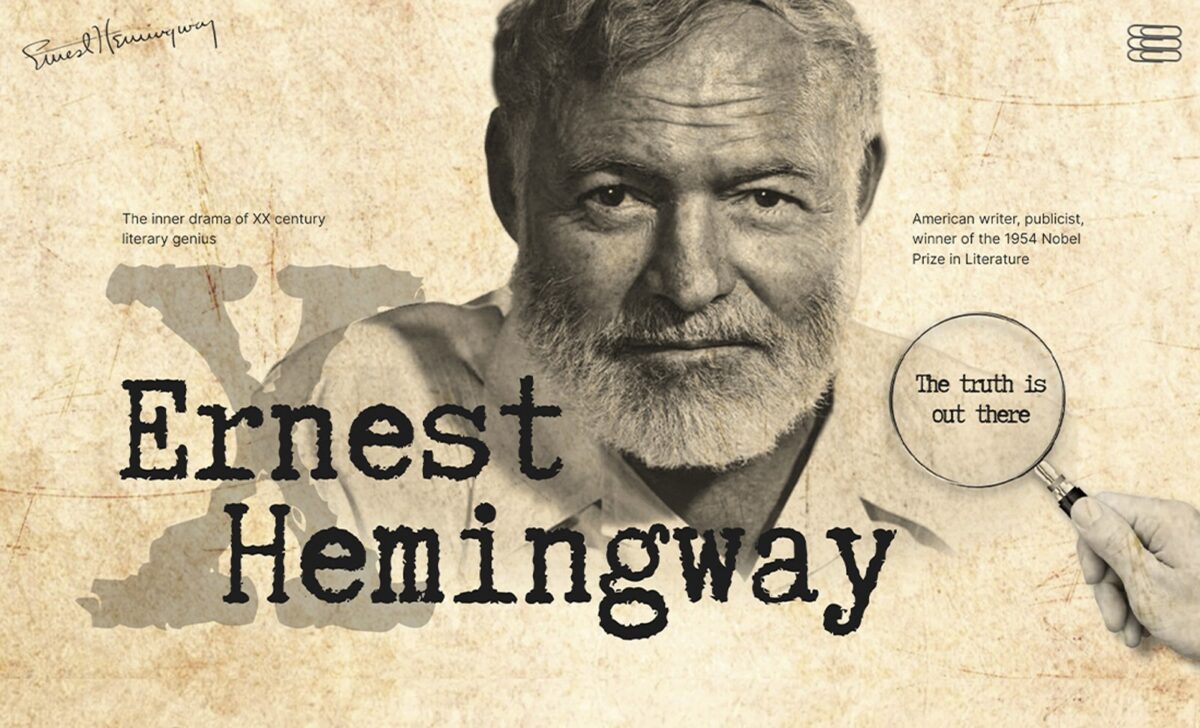
Ernest Hemingway opened his eyes. Then he closed them again. When he reopened them, nothing had changed.
He found himself sitting on a fine leather davenport, perhaps the richest leather he had ever felt, with no idea where he was or how he had got there. He doubted he was still in Idaho. If this place existed in Idaho, he surely would have found it by now.
And where was Mary? His fourth wife should have been at his side in this strange journey. He didn’t see her anywhere, and that thought frightened him.
The last thing he remembered was sticking a shotgun into his mouth.
Then pulling the trigger.
Was he alive? Was he dead?
He ran his hands over his head. Everything seemed intact. No wound. No blood. He looked down at his palms. Clean.
“What the hell?” he muttered.
Had it all been a dream? If so, it had been a terrible one.
Yet for the first time in years, he felt at peace.
The anxiety was gone. The depression that had stalked him for so long had vanished. More importantly, the wall that had blocked his writing had disappeared.
Sentences began forming effortlessly in his mind. Characters. Dialogue. Entire paragraphs.
It was as though someone had unlocked a door that had been bolted shut.
Where was his Royal typewriter? He needed to get these thoughts down before they escaped him.
After a few minutes he rose to his feet. He was unsteady at first, but soon stood tall, stretching his six-foot frame.
Only then did he truly look around. The library was enormous.
Oak shelves stretched from floor to ceiling. By his estimation, the structure rose ten stories high, each level lined with walkways and ladders. Thousands upon thousands of books filled the shelves.
People wandered the aisles.
Others sat around tables drinking coffee, smoking cigars, and puffing on pipes while engaged in animated conversations.
Coffee. That sounded wonderful.
He approached a small coffee stand tucked into one corner of the room.
“Black,” he said.
While waiting, he noticed a calendar hanging behind the counter.
July 2.
The same day. The same damned day.
The barista handed him a cup. “Twenty-five cents.”
Hemingway stared.
Twenty-five cents for coffee? Highway robbery. It hadn’t cost that much before he put a shotgun in his mouth.
Just then a voice behind him grumbled:
“Damn place. Charging two-and-a-half times what coffee ought to cost. They ought to be thrown in jail.”
Hemingway turned.
The man standing behind him wore a crisp white suit and sported a large white mustache.
The resemblance was astonishing.
The man looked exactly like Mark Twain.
Coffee in hand, Hemingway took a table near the door and watched.
The old gentleman continued complaining about the price before tossing a quarter onto the counter and turning to leave.
Hemingway couldn’t help himself.
“Sir, you look like Mark Twain.”
The man stopped. Slowly, he turned.
Then he looked at Hemingway as though he had lost his mind.
“Sir,” he said, “you are the most industrious fool I have encountered in many years.”
He jabbed a thumb toward his chest.
“By God, I am Mark Twain.”
Then he walked out.
Hemingway sat frozen. Not because of the insult. Because Mark Twain had been dead for fifty-one years.
He stared at the doorway long after Twain disappeared.
Am I dead? The question returned for the hundredth time. How else could he be standing in the same room with Samuel Clemens?
Then the memory returned. The bitter metallic taste of the shotgun barrel. The struggle to summon the courage. The false starts. The hesitation. Three attempts. Maybe four.
The last one had worked.
After that, nothing. Nothing until the davenport. Nothing until the library. Nothing until Twain.
He rubbed his eyes and tried to make sense of it all. If this was Heaven, it was unlike any version he had ever imagined. If it was Hell, it was certainly the most pleasant section of it.
He made a mental note that if he saw Twain again, he was going to ask him about Halley’s Comet. Twain had famously been born during its appearance in 1835 and predicted he would die when it returned. It was exactly the sort of thing Twain would do.
Hemingway finished his coffee and began exploring.
Before long, he noticed a pattern. American authors occupied the first floor. The books were arranged alphabetically. Every author had a section. Every section contained every book that author had written.At least, that was what Hemingway believed at first.
He started at “A” and worked his way down the aisle.
Many of the names were familiar. Others weren’t. The books themselves were magnificent. Every volume was bound in rich leather with gold lettering.
Eventually he stopped at a title that caught his eye.
Sanditon.
Jane Austen.
He knew enough literary history to know Austen had died before completing the novel. Curious, he pulled it from the shelf. The book was finished.
He opened it. Read the final chapter. Then the last page. The story ended cleanly. Completely. As though Austen herself had finished it.
Hemingway carefully returned it to the shelf.
His pulse quickened. A coincidence, perhaps. He continued.
The next discovery was even stranger. The Mystery of Edwin Drood by Charles Dickens.
Everyone knew Dickens died before finishing it. For nearly a century readers had argued over who killed Edwin Drood. The popular theory was John Jasper.
Hemingway removed the volume and flipped to the final chapters. The mystery had been solved. But not as expected. Jasper wasn’t the killer. Neville Landless was.
Hemingway blinked. Then read the ending again. It was perfect. More importantly, it felt like Dickens. The same misdirection. The same dramatic reveal. The same voice.
He slid the book back into place.
“What the hell is this place?” he whispered.
The answer did not come. He moved on.
Soon he arrived at Arthur Conan Doyle’s section. Every Sherlock Holmes story was there. Every Professor Challenger adventure. Everything Doyle had ever written.
Then he noticed one final book at the end of the shelf.
The Last Manuscript of Arthur Conan Doyle
By Alan N. Webber
Published 2025
Hemingway frowned. He had never heard of either the book or the author. He removed the volume and began skimming the pages.
“Don’t look at me. I never wrote it.”
The voice nearly made him drop the book.
Arthur Conan Doyle stood beside him. The famous mustache. The broad frame. The unmistakable face.
Doyle snatched the book from Hemingway’s hands.
“Let’s have a look at this nonsense.”
He thumbed through several pages. Then another. And another. Finally he stopped.
“Good Lord.”
“What?”
Doyle looked horrified.
“This bloke has me chasing Sherlock Holmes.”
Hemingway laughed despite himself. Doyle thrust the book back into his hands.
“I shall have to investigate this immediately.”
“Investigate what?”
“Whoever wrote this absurdity.”
With that, Doyle stormed away.
Hemingway watched him disappear into the stacks.
“First Twain,” he muttered. “Now Doyle.”
A familiar voice answered.
“You’ll get used to it.”
Twain stood behind him. Hemingway jumped.
“I didn’t hear you.”
“Most people don’t.”
Twain nodded toward the shelves.
“Starting to understand things?”
“A little.”
Twain snorted.
“I’ve been here fifty-one years and still don’t understand it.”
“You don’t?”
“Nope.”
Twain shoved his hands into his pockets.
“But I can show you around.”
Together they wandered deeper into the library. Twain led him to completed versions of unfinished works.
Billy Budd.
Weir of Hermiston.
The Castle.
The Trial.
Great books abandoned by death. Books interrupted by illness. Books left behind on desks and nightstands and in desk drawers.
All completed. All exactly as their authors would have written them. At least that was how they appeared.
Finally Twain stopped in front of his own section. He pointed to a familiar title.
Tom Sawyer’s Conspiracy.
“I got just ten chapters into that one before Halley’s Comet came back for me.”
Hemingway removed the book. The volume contained thirty-four chapters. It was complete.
“I didn’t write the last twenty-four chapters,” Twain said. “But if you read them, they sound exactly like me.”
Hemingway stared.
“How is that possible?”
“In tarnation, I haven’t the slightest idea.”
Twain grinned.
“You haven’t seen the best part yet.”
He began walking again.
As they moved through the aisles, Twain glanced over his shoulder.
“You know, Ernest, there’s a fellow down in Arizona who’s going to spend an entire afternoon convincing people he isn’t you.”
“What?”
“Never mind.”
Twain waved it away.
“Long story.”
Eventually they reached the H section. Hemingway’s section. His books stood in a neat row.
The Sun Also Rises.
A Farewell to Arms.
For Whom the Bell Tolls.
The Old Man and the Sea.
His finger moved slowly across each spine. Then it kept going. His hand stopped. There were more books. Novels he had never written.
Books he had intended to write. Books he had only imagined.
The Garden of Eden.
Islands in the Stream.
A Moveable Feast.
His breathing quickened. Then he saw one final volume.
The Snows Beyond Kilimanjaro.
He pulled it from the shelf. The book felt warm in his hands.
“But I never wrote this.”
Twain smiled.
“No.”
“I barely even conceived it.”
“No.”
Hemingway stared at the cover. Then at Twain.
“Then where did it come from?”
Twain’s grin widened.
“Most fellows come looking for the books they left unfinished.”
He nodded toward the shelf.
“But the smart ones go looking for the books they never knew they had in them.”