


AN INTERRUPTED BONANZA
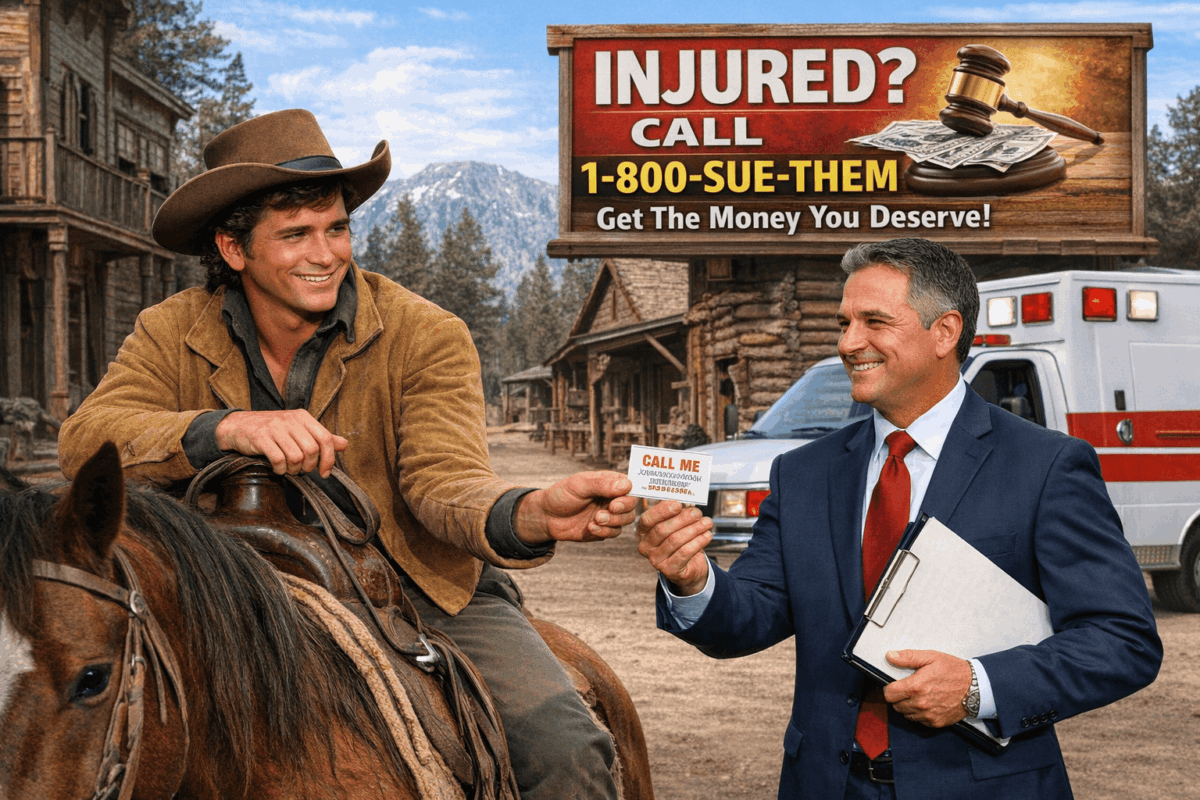
Last Sunday morning, I was home lamenting the one shot I should have made before I lost a golf tournament… by one point. After breakfast, I turned on a rerun of Bonanza, a show I’ve liked since I was a kid. Little Joe was teaching sign language to an unfortunate young lady.
Then the program broke for commercials.
What followed wasn’t so much a commercial as a presentation. Within a minute, I found myself watching a law firm explain, in great detail, what I should do if something terrible ever happened to me. To make the point stick, they even brought in a retired NFL player to lend credibility to the message.
The commercial was polished and reassuring. Almost comforting. Particularly, I suppose, if you were at home recovering from being run over by a herd of brightly dressed bicyclists.
And yet, something about it felt…off.
Before going any further, I have no issue with lawyers in general. I’ve known and worked alongside several over the years, and they’ve done exactly what they were hired to do, to represent our best interests and keep things in line. And not one of them sold their services on a billboard.
This isn’t about them.
This is about a specific category of lawyer, the kind that seems to be there the moment something goes wrong. They used to be called ambulance chasers before it became such a colossal business.
Personal injury law has become a massive business.
Law firms spend over $2.5 billion a year on advertising. That translates into millions of ads on television and billboards, all designed to reach injured people, and not particularly usually at their best.
It’s all about the economics.
Most of these firms work on contingency. If a case has merit they take you on – if not, they toss you aside. If a case settles, they take somewhere between 33% and 40%. On a $1 million settlement, that’s at least $330,000 going to the attorney, before medical bills or other costs are even considered.
With that kind of return, spending thousands to acquire a single client isn’t just reasonable, it’s expected. In fact, an entire secondary industry has formed around it. Lead generation companies run ads of their own, capture potential clients, and then sell those leads to law firms for $500 to $2,000 apiece.
No one spends that kind of money to find you unless they expect to make more once they do. Which means, somewhere along the way, misfortune stopped being unfortunate and became a commodity.
Before 1977, lawyers weren’t allowed to advertise. It was considered unprofessional, even unethical. That changed with the Supreme Court case Bates v. State Bar of Arizona, when the Court decided that legal advertising was protected as free speech.
At the time, that decision made sense. People should know where to find help. Information should be available. What no one considered was what would happen once help started to look like marketing campaigns.
Over time, the scale changed.
The tobacco settlement in the late 1990s resulted in over $200 billion paid out, with over fifteen billion dollars going to attorneys. Decades later, opioid litigation followed a similar pattern of massive settlements, massive fees, and a system designed to process not just your claim, but thousands of them.
At some point, litigation stopped being just a response to harm. It became a model.
Sitting there, waiting to see if Little Joe accomplished his lesson, I found myself less interested in the law firm and more interested in the presentation itself.
How much was the former football player paid to be part of it? Why was he needed? How carefully was that message constructed? And just when, exactly, did this all start to feel normal?
Because it does feel normal now.
We’ve always had commercials. Some of them were memorable. Clydesdale’s running through snow, someone asking where the beef was, a man regretting that second helping.
But those were creative interruptions.
This feels different.
Now the message isn’t just memorable, it’s expected. And not for something you might want, but for something you hope never happens.
Then something goes wrong. Someone appears. A phone number follows. “Call this number right now. We’ll take it from here.”
And just like that, you realize the worst moment of your week has already been anticipated, priced, and prepared for you in advance.