

THIS ISN’T POLITICS ANYMORE – IT’S A MORAL FIGHT
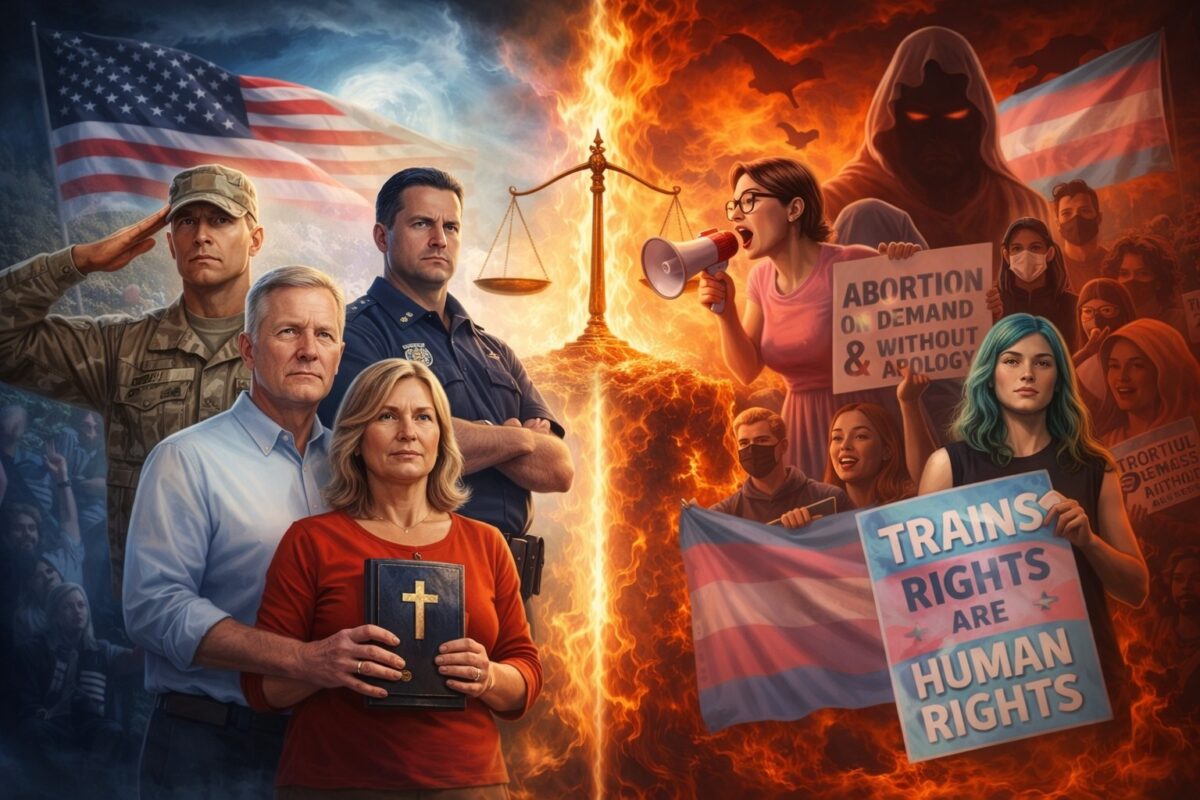
We need to be honest about right and wrong instead of playing political games. This moment calls for clear thinking and genuine values, not pretending or hiding behind slogans. Sometimes, stepping up with straightforward honesty is what matters most.
Americans have long been told the solution to our nation’s issues is simple: sit down, have a face-to-face conversation, and find common ground. That idea sounds noble. But I wonder if that approach still works now that the divide isn’t just about tax rates or infrastructure spending, but about basic moral beliefs.
There was a time when Republicans and Democrats could debate policy while still agreeing on basic values like love of country, respect for faith, support for law enforcement, and a shared understanding of biological and moral realities. That common foundation no longer seems as strong as it once was.
The main issue often comes down to patriotism. Conservatives view America not as a broken experiment needing a complete overhaul, but as the greatest champion of freedom in history, imperfect, certainly, but still exceptional. Others describe America as deeply oppressive or fundamentally unfair. I see that less as helpful criticism and more as an attack on the country’s founding values. When one group wants to strengthen the nation and another wants to tear it down and start over, finding common ground becomes much harder.
Faith is another dividing line. For many Americans, Christianity isn’t just a personal belief; it shapes how they understand right and wrong, family life, and respect for others. When cultural and political movements push traditional Christian views on life, marriage, and gender to the sidelines, it feels like more than a disagreement. It feels like a challenge to values that have long shaped Western civilization. Being told to “meet in the middle” on moral absolutes doesn’t feel like cooperation. It feels like surrender.
Law enforcement and the military are also major points of tension. Many people see police officers and service members as symbols of sacrifice, stability, and order. Critics of policing often argue that the system can be unjust, while others worry that portraying law enforcement primarily as oppressive or pushing major funding cuts could weaken public safety. Likewise, hesitation to project American strength abroad is often viewed as weakening deterrence in a dangerous world. For people who prioritize security and stability, those positions can seem reckless rather than practical.
One of the most deeply felt issues today involves life and gender. Conservatives see the unborn as human beings deserving protection. When states expand abortion access late in pregnancy, and in some cases even after birth, it raises serious moral concerns for many Americans. Society must clearly define what it means to protect life. Human life is sacred and should not shift with political trends.
Gender issues involving youth raise similar concerns. Many believe biological differences must be considered when addressing fairness in sports and privacy in locker rooms. Parents also worry when gender theories become widespread in schools and culture, because they believe children need steady guidance and clarity, not confusion.
When these concerns accumulate, patriotism, faith, law enforcement, life, and family, they begin to feel less like policy disagreements and more like moral conflicts. These are questions of right and wrong, not just politics. As that gap widens, calls for polite bipartisan dialogue can start to feel disconnected from the seriousness of the debate.
This doesn’t mean conservatives want endless conflict or reject civil discourse. But it does mean many believe unity cannot be built on moral relativism. Real agreement requires shared starting points. If one side believes truth is fixed and rooted in tradition while the other believes truth evolves over time, conversation alone may not bridge the gap.
Frustration also comes from a growing lack of trust. Some voters feel that politicians who present themselves as moderate often support more progressive policies once in office. That perception makes people skeptical of negotiations and political promises. If compromise consistently moves policy in one direction, many begin to question whether it is truly compromise at all.
In the end, this moment tests the strength of our convictions. America may be facing a choice: hold firmly to its core values or drift into cultural and moral uncertainty. The debate is not about scoring political points. It is about protecting principles that many believe are timeless truths.
Whether you agree with this perspective or not, it reflects a genuine concern shared by millions of Americans. For them, the issue goes beyond ordinary politics. It is a struggle over the character and future of the nation—and one they believe cannot be solved by polite conversation alone. If political leaders fail to address these concerns honestly and fairly, many believe it will ultimately be up to the American people to take action.