


ARE AMERICAN CEOs PAID TOO DAMN MUCH?
You may not have guessed this about me, but I’m a conservative. Not a Republican, but a conservative. I align more closely with the Tea Party or MAGA than with the Republican Party, a party with far too many RINOs (Republicans in Name Only) for my liking. And I believe passionately in the American system of capitalism.
I tell you all that because, by the time you’ve finished reading my thoughts for today, you might begin to question my capitalist credentials.
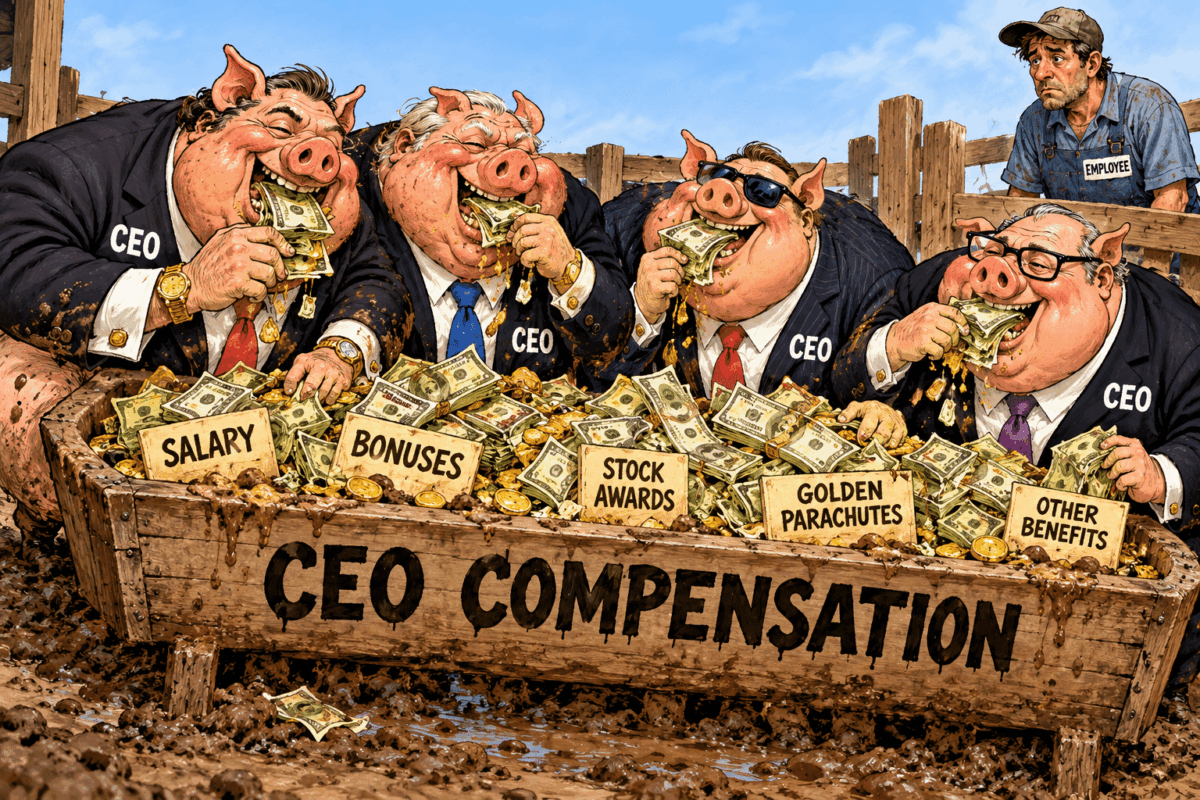
The fact is, I believe American CEOs, particularly those who neither founded nor own the companies they run, are paid too damn much. And it’s time shareholders started paying attention.
I’m not talking about people like Elon Musk, Jeff Bezos or that weird little fellow, Mark Zuckerberg. They had the ideas, built their businesses and took the risks. They have sweat equity in their companies, something I know a little about. They should make whatever they can, even if the amounts border on absurdity.
I’m talking about the hired executives who never built the companies they run and may have little of their own money at risk. Many have impressive degrees, extensive corporate experience and, I suspect, considerably more luck than the fellow working on the factory floor. They climb the corporate ladder, negotiate compensation packages worth millions, collect their golden parachutes when things go wrong and occasionally move on to another corporation to begin the cycle all over again.
Take the automobile industry, for instance.
Mary Barra heads General Motors, which sold approximately 6.18 million vehicles worldwide in 2025. For her efforts, Barra received nearly $30 million in total compensation, including salary, bonuses and stock awards.
Meanwhile, GM’s median employee received just under $90,000 in total annual compensation. It would take the combined annual compensation of 333 typical GM employees to equal what Barra received in a single year.
It’s much the same over at Ford, where CEO Jim Farley received approximately $27.5 million in 2025, compared with $93,000 for the company’s median employee. A typical Ford employee would have to work nearly 295 years to earn what Farley received in one.
Ford, by the way, reported an $8.2 billion net loss in 2025.
Henry Ford must be rolling over in his grave.
Now consider Toyota, the world’s largest automobile manufacturer. Led by Koji Sato during its most recently reported compensation year, Toyota sold more than 11.3 million vehicles worldwide in 2025, nearly as many as GM and Ford combined.
Toyota reported approximately $314 billion in annual revenue for its fiscal year ending in March 2025. Sato’s compensation was approximately $5.5 million, less than one-fifth of Barra’s.
One might think Ford and GM could hire their Japanese counterparts, double their compensation, send their current CEOs packing and still come out money ahead.
Another eye-opening example comes from the semiconductor industry.
Broadcom CEO Hock Tan received an astonishing $205.3 million in reported compensation for 2025, mostly in stock awards. His company, however, reported revenues of $63.9 billion, more than double its 2021 revenue.
Over at Intel, Pat Gelsinger received a compensation package valued at approximately $179 million when he became CEO in 2021. Intel’s fortunes went in the opposite direction. Revenues declined substantially, and Gelsinger departed in December 2024.
Now, before somebody writes to tell me I don’t understand executive compensation, I realize these figures aren’t simply salaries deposited into checking accounts every Friday. They include stock awards, bonuses and incentives. But we’re still talking about extraordinary sums of money.
A recent study of major American corporations found median CEO compensation of approximately $17.7 million in 2025. That’s more than $48,000 per calendar day, compared with about $247 for an employee earning $90,000 annually.
Both work for the same company. Both contribute to its success. One carries greater responsibility, but is that responsibility worth nearly 200 times the compensation?
I’m not suggesting government establish some arbitrary limit on what corporate executives can earn. That would be contrary to everything I believe about free enterprise.
But capitalism is supposed to reward innovation, risk, investment and results. Somewhere along the way, we seem to have added another category: occupation of the executive suite.
And that brings me back to the people who actually own these publicly traded corporations: the shareholders.
If a board of directors wants to hand somebody $30 million a year, it ought to demonstrate, with a straight face, why that individual is worth $30 million. Not because another corporation pays its CEO that much or because some compensation consultant says it’s “competitive.”
If shareholders don’t start demanding accountability from corporate boards, they shouldn’t be surprised when the people running their companies continue helping themselves to an ever-larger piece of the pie.
After all, it’s a lot easier to be generous when you’re spending somebody else’s money.