


THE BOY WITHOUT A BICYCLE
PART 1
On an early October morning in Green Bay, Wisconsin, a group of ten boys ranging in age from eleven to thirteen had gathered outside Lambeau Field with their bicycles. They were waiting for the Green Bay Packers players to come out of the locker room and make their way across Oneida Street to the practice field.
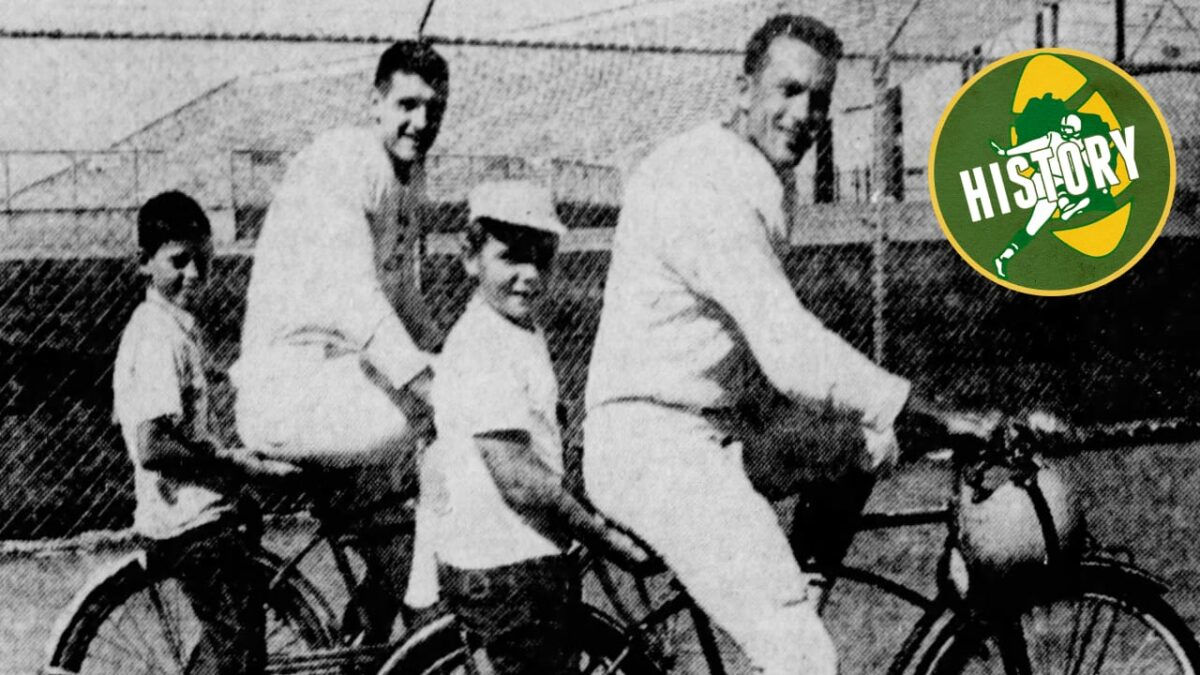
The players would ride the boys’ bikes over.
Johnny was the leader of the group and had the newest bike, a Schwinn Sting-Ray with a banana seat, gearshift lever on the crossbar, hand brakes, and a sissy bar on the back. It was the envy of every boy in the group.
Johnny even assigned the boys which players they could loan their bikes to. That rankled the others because Johnny always reserved his bike for Paul Hornung, the running back who was the favorite among most of the boys.
One of the boys, Bobby, was usually there too, although Bobby didn’t have a bicycle. His father had been killed in a truck accident a few years earlier, and his widowed mother simply didn’t have the money to buy bicycles for Bobby and his six brothers and sisters.
Johnny and a few of the other boys sometimes made fun of Bobby for not having one.
But Bobby was as avid a Packers fan as any of them and marveled each time the players came out of Lambeau Field. He’d hang back as the others handed over their bikes, then walk across to the practice field, arriving long after the players and the rest of the boys had made the trip across Oneida.
On this particular Saturday, the entire city was abuzz. The Packers would play the hated Chicago Bears at Lambeau the following afternoon.
Bobby couldn’t wait. Unlike the other boys, he had never actually been to a Packers game. There simply wasn’t money for such things at home, so he listened on his small transistor radio, tuned to WJPG, 1440 AM.
The radio had been a Christmas present a few years earlier, and he cherished it. The NFL’s blackout rule meant home games weren’t televised locally anyway, and everyone loved listening to Ted Moore call the Packers games on the radio.
Finally, the players came out, and the boys loaned their bikes to their “assigned players.” In no time, the Packers were pedaling across the east parking lot toward Oneida Street, with the boys running alongside or behind them, yelping it up. Sometimes a player would let the bike’s owner ride along, perched on the frame or squeezed onto the back of a banana seat.
Bobby started walking behind them and quickly fell behind. He saw no reason to run. It wasn’t worth the energy. It wasn’t like any of the players were going to talk to him anyway.
About halfway through the parking lot, a man joined him. Bobby had no idea who he was or why he was walking toward the practice field. He was an older man with curly blond hair, much like Paul Hornung’s.
“What’s your name?” the man asked in a soft voice.
“Bobby.”
“You a Packer fan, Bobby?”
Bobby looked up at him with a quizzical expression.
“Who ain’t?”
The man smiled.
“Who’s your favorite player?”
“On offense or defense?”
“Well, I guess both.”
“That’s easy, mister. Bart Starr on offense and Ray Nitschke on defense. The guys there all like Paul Hornung, but to me, Starr’s the man that makes this team.”
“Those are some pretty good choices, Bobby.”
“Thanks. But that was an easy question.”
“You goin’ to the game Sunday?”
“Naw. My mom can’t afford it. I’ll just listen on my radio.”
“Your dad never took ya to a game?”
“No, sir. Dad was kilt in an accident a few years ago. He was a truck driver, and some lady with kids in the car ran him off the road. Mom said Dad was a hero for not hitting that car.”
They walked a few more steps in silence before the man spoke again.
“How’d you like to go to the game with me Sunday, Bobby?”
Bobby stopped dead in his tracks and looked the man over.
“Gee, mister, that’s a swell offer, but I don’t know if Ma would let me.”
“Well, I’ll tell ya what, Bobby. You ask her for permission, and if she says yeah, you meet me by Gate 9 at twelve sharp. I’ll have a ticket for ya, and we can watch the game together.”
By the time they reached the practice facility, the players had all gone in and most of the boys had left. The man said goodbye, reminded Bobby again to ask his mother, and then went inside.
Bobby ran all the way home as fast as his legs would carry him.
At first, his mother was hesitant, especially since Bobby didn’t even know the man’s name. She said she’d think about it and then reminded Bobby that it was his turn to mow the yard.
Bobby wasn’t taking any chances, so he mowed their small yard twice and then washed her beat-up old Dodge.
Sunday morning, Bobby was up early, waiting anxiously for his mother to get out of bed. The moment she walked into the living room, he asked her again.
By the look on her face, it was obvious the whole thing had slipped her mind, in complete opposition to Bobby, who had thought of little else since the man had asked him.
“I don’t know, Bobby. We have church this morning, and you have some chores to do…”
“I already did ’em, Ma. And church’ll be done by ten, which gives me plenty of time to meet him at Gate 9.”
She looked down at her son with trepidation. She didn’t like the idea of him attending a football game with a man neither she nor Bobby knew.
But she could tell how much it meant to him. And she knew she would never be able to take him herself. Finally, against her better judgment, she relented.
“You go and get ready for church, and I’ll drop you off at the stadium afterward. Have you got money for a Coke and a hot dog?”
Bobby scrounged around in his pants pockets and pulled out two crumpled dollar bills. She gave him another one.
“You’re gonna have to walk home from the game, ya know.”
He looked up at her and smiled.
“Is it okay if I run?”
PART 2
Bobby had no idea what the minister said that Sunday morning in church. He could think of nothing but the game.
When church let out, he jumped into the backseat of the car before his brothers and sisters so he’d have room to take off his church shirt and put on his faded Packers T-shirt. He figured he’d probably be cold wearing nothing but a T-shirt, but that didn’t matter. If he was going to his first Packers game, everyone needed to know he was a Packers fan through and through.
Bobby’s two younger brothers couldn’t believe he was actually going to the game and whined to their mother about why they couldn’t go too.
She dropped Bobby off near the stadium, but not before giving him a stern lecture about how to behave, where to meet the man, and what time he should come home.
Bobby barely heard her.
He sprinted through the growing throng of people until he found Gate 9. He was twenty minutes early, but the man wasn’t there yet. Bobby positioned himself directly beneath the Gate 9 sign, where there was no chance the man could miss him.
As he waited, he began to get cold, but he shrugged it off.
About ten minutes later, the man arrived. He was dressed neatly in slacks and a light tan coat over a button-down shirt. Bobby was somewhat amazed that the man wasn’t wearing anything that said Packers on it.
“Bobby! Your Ma said you could come. I’m delighted.”
“Yeah. She said I was old enough now,” Bobby lied.
“You look cold.”
“I’ll make it through. Heck, I’d take off my shirt if that’s what it took to see a Packer game.”
The man laughed, and they entered the stadium.
They hadn’t gone far when the man stopped near a stand selling Packers souvenirs.
“Bobby, I don’t want you freezing all afternoon. Why don’t we find you something warmer?”
“Gee, mister, I can’t afford anything. I’ve only got three dollars for a Coke and a hot dog.”
“I’ll tell ya what. I’ll buy it, and you can pay me back someday when you’re earning a little money.”
Bobby couldn’t believe his luck.
He looked through the sweatshirts, running his hands over each one. There were green ones, white ones, and yellow ones. Finally, he chose a yellow sweatshirt with a large Green Bay Packers emblem across the front.
The man paid for it.
“Put it on, Bobby.”
Bobby pulled it over his head and looked down admiringly at the emblem. It showed up a whole lot better than the one on his faded T-shirt.
Next, they stopped at a concession stand. Bobby ordered a hot dog and a Coke, but when he reached into his pocket for his money, the man had already paid.
“You keep your money, Bobby. You’re my guest today.”
Things got even better when they reached their seats. Bobby stopped and stared.
They were near the 50-yard line, only about six rows from the field.
“These are our seats?”
The man smiled. “They are today.”
Bobby couldn’t imagine how anyone could have better seats for a football game.
They had barely settled in when the Chicago Bears came onto the field to a thunderous chorus of boos. Bobby joined in enthusiastically.
Then came the Packers. The stadium erupted.
Bobby jumped to his feet as the familiar green and gold uniforms poured onto the field. There was number 15, Bart Starr, the man Bobby had told his new friend was the player who made the Packers go.
For the first time in his life, Bobby wasn’t listening to Ted Moore describe it on his little transistor radio. He was there.
The first quarter couldn’t have gone much better.
Paul Hornung scored from the 1-yard line, and Don Chandler kicked the extra point to put Green Bay ahead 7–0.
Then Lee Roy Caffey intercepted a pass from Bears quarterback Billy Wade and raced 42 yards for another touchdown.
Bobby screamed himself hoarse.
The Packers led 14–0.
In the second quarter, Starr found Bob Long for a spectacular 48-yard touchdown pass. Chandler’s extra-point attempt was blocked, but Bobby didn’t care.
At halftime, the Packers led the much hated Bears 20–0.
During the break, Bobby gave the man his analysis of everything the Packers had done right and everything the Bears had done wrong, in only the way a twelve-year-old could.
The man listened intently, occasionally nodding and smiling as Bobby explained football to him.
“You know quite a bit about this game, don’t you?”
“I listen to every game.”
“I can tell.”
Bobby couldn’t wait for the second half.
Early in the third quarter, Chandler kicked a field goal.
23–0.
The rout was on.
At least Bobby thought so.
But the Bears had a rookie named Gale Sayers.
Sayers scored on a 6-yard run to make it 23–7. Then, in the fourth quarter, he caught a pass from Rudy Bukich and raced 65 yards for another touchdown.
Even Bobby had to admit the guy was something else. But that was all Chicago would get.
When the final seconds disappeared from the clock, the scoreboard told Bobby everything he needed to know:
GREEN BAY 23
CHICAGO 14
The Packers were 3–0.
Bobby had attended his first football game, watched Bart Starr lead his beloved Packers to victory over the Chicago Bears, eaten a hot dog, drunk a Coke, and was going home wearing the finest sweatshirt he had ever owned.
He couldn’t imagine a better day.
After the game, Bobby hurried home to tell his mother and brothers everything that had happened.
His mother immediately noticed the sweatshirt.
“Where did you get that?”
“The man bought it for me. He said I could pay him back someday when I was making money.”
She examined the sweatshirt and shook her head.
“That was awfully nice of him. What’s his name? I should send him a thank-you note.”
Bobby’s face went blank. In all the excitement, he’d never asked.
“I don’t know.”
“You spent the entire afternoon with the man, and you don’t know his name?”
Bobby shrugged. “I guess I forgot to ask.”
The following morning, Bobby bought a newspaper on his way to school and immediately turned to the sports section.
Starr had completed 11 of 20 passes for 263 yards, with one touchdown and no interceptions. Hornung had rushed for 33 yards and a touchdown and caught three passes for another 85 yards.
Bobby carefully cut the statistics from the newspaper.
When he got home, he pinned the clipping to his bedroom wall.
Right underneath his new Packers sweatshirt.
PART THREE
That week, everyone treated Bobby differently.
The other boys couldn’t believe that Bobby, the kid without a bicycle, the kid they sometimes made fun of, had actually gone to the Packers game while they hadn’t. And it was against the Bears! Bobby delighted in showing them his ticket stub, which he carefully tucked away in his bedroom and vowed to keep forever.
Years passed. Bobby graduated from high school without ever attending another Packers game. He never saw the mysterious man who had taken him to that game, either.
A few years after high school, he married his high school sweetheart and took a job at one of the paper mills, considered one of the best jobs in Green Bay for an “uneducated man.”
By then, Packers games were regularly available on television, and Bobby watched religiously every Sunday, always hoping that someday he’d make it back to Lambeau.
Before long, his wife gave birth to a son. They named him Bart.
Two daughters followed, and Bobby, now called Bob by everyone except his mother, steadily worked his way up at the paper mill.
In 1987, the mill held a contest recognizing the employee who had contributed the most to the company’s success that year. Bob won in a landslide.
The prize was two tickets to the upcoming Packers-Bears game at Lambeau Field.
There was never any question who would get the second ticket.
Bob took his ten-year-old son, Bart.
They arrived early that Sunday, and Bob decided to take his son to the Green Bay Packers Hall of Fame before the game.
Bart wasn’t particularly interested in spending his morning looking at old football memorabilia. He wanted to see the Packers play.
Bob, however, was fascinated.
He stopped at nearly every exhibit, studying the photographs, uniforms and artifacts from the team’s past while Bart impatiently followed behind.
Then Bob came to the Don Hutson exhibit.
He stopped.
Every Packers fan knew the name Don Hutson. Bob certainly did. Hutson was one of the greatest players ever to wear a Packers uniform.
But Bob had never paid much attention to what Don Hutson looked like.
Now he stared at the photograph.
Curly blond hair.
The same eyes.
The same smile.
Bob moved closer.
“Dad?”
Bob didn’t answer.
“Dad, what’s wrong?”
Bob continued staring at the photograph.
Suddenly, he was twelve years old again, walking across the parking lot at Lambeau Field alongside a stranger.
“What’s your name?”
“Bobby.”
“You a Packer fan, Bobby?”
Bob felt a chill run through him.
He remembered the tan coat and the soft voice.
The hot dog, Coke, and yellow Packers sweatshirt that the man had bought for him.
The sixth-row seats near the 50-yard line.
And that face.
“Dad?”
Bob finally looked at his son.
“I know him.”
Bart looked at the photograph and then back at his father.
“You know Don Hutson?”
Bob shook his head slowly.
“No. I mean…I met him once.”
Bart stared at him.
“When?”
“A long time ago.”
“Let’s go, Dad. The game’s gonna start.”
Bob reluctantly pulled himself away from the exhibit, but as they made their way toward their seats, he couldn’t get Don Hutson’s photograph out of his mind.
The Packers of 1987 were a far cry from the team Bob had watched with the mysterious stranger twenty-two years earlier. The glory days of Lombardi, Starr, Hornung, Taylor and Nitschke were long gone.
But this was still Packers-Bears at Lambeau Field.
And for Bob, there was something special about sitting beside his ten-year-old son watching the same rivalry he had witnessed at his own first game.
The Packers gave Bob and Bart plenty to cheer about. Green Bay led 21–13 at halftime, and father and son began to believe they might actually pull it off.
The Bears fought back in the second half and eventually took a 23–21 lead. With about a minute remaining, Packers kicker Al Del Greco lined up for a 47-yard field goal.
He made it. Lambeau erupted.
Packers 24. Bears 23.
Bob and Bart were on their feet, screaming along with everyone else.
“WE GOT ‘EM, DAD!”
Bob thought so too.
But Bears quarterback Jim McMahon wasn’t finished.
He quickly moved Chicago down the field, and with the final seconds ticking away, Bears kicker Kevin Butler came out to attempt a 52-yard field goal.
Bob watched the snap. The kick went up.
And through.
The clock showed nothing but zeros.
Bears 26. Packers 24.
Bart dropped back into his seat. “That stinks.”
Bob laughed and put an arm around his son.
“Yeah, it does.”
Twenty-two years earlier, Bob had watched the Packers beat the Bears 23–14 in his first game at Lambeau.
Now he’d brought his own son to see the same two teams, only to watch Chicago win on the final play.
During the ride home, Bart talked about the game, but Bob’s thoughts kept drifting back to the photograph he’d seen in the Hall of Fame.
When they reached the house, Bart ran to his room while Bob pulled out a book about Packers history his wife had given him for Christmas. Tucked between the pages was the ticket stub from that October afternoon in 1965. Bob held it for a moment, remembering the twelve-year-old boy who had carefully saved it twenty-two years earlier.
He laid the stub beside him and leafed through the pages until he found the chapter on Don Hutson. He made a mental note to find a Hutson football card, provided it didn’t cost an arm and a leg.
Then he began to read. The more he read, the more dumbfounded he became.
Hutson had played for Green Bay from 1935 through 1945 and had been one of the most dominant players the game had ever known. He won two NFL Most Valuable Player awards, helped the Packers win three championships, and retired with receiving records that would stand for decades.
In 1963, just two years before Bobby met him, Don Hutson had become a charter member of the Pro Football Hall of Fame.
Bob closed the book and sat quietly. He thought back to that October Sunday in 1965.
Don Hutson, one of the greatest players in Packers history and a Hall of Famer, had noticed a twelve-year-old boy walking alone across a parking lot simply because he didn’t own a bicycle.
Hutson had talked football with him.
Bought him a sweatshirt.
Bought him a hot dog and a Coke.
And taken him to his first Packers game.
All without once mentioning who he was.
Bob smiled and shook his head.
He had spent an entire afternoon sitting beside one of the greatest football players who had ever lived. And he had never even bothered to ask the man’s name.
Then another thought occurred to him.
Don Hutson had never bothered to tell him.