

272 WORDS THAT OUTLIVED 13,000
“Four score and seven years ago our fathers brought forth on this continent, a new nation, conceived in Liberty, and dedicated to the proposition that all men are created equal.”
For those over the age of 50, you very well might have been assigned to memorize Abraham Lincoln’s Gettysburg Address in school. If you weren’t, you probably still know something about Lincoln’s great speech and the horrendous battle that preceded it.
For those of you under 50, if you weren’t taught about it, shame on the school system. But now would be a good time to bone up on it. The Gettysburg Address is one of the most famous speeches in American history.
“Now we are engaged in a great civil war, testing whether that nation, or any nation so conceived and so dedicated, can long endure.”
The Battle of Gettysburg, fought in Pennsylvania from July 1 through July 3, 1863, pitted Robert E. Lee’s Army of Northern Virginia against George Meade’s Army of the Potomac. It was the largest battle of the Civil War and one of the largest ever fought in North America.
By the time it was over, more than 50,000 men had been killed, wounded, captured or reported missing, roughly the population of Normal, Illinois.
The first day produced roughly 15,000 casualties. The second was worse, with approximately 20,000 more. Then came July 3 and Pickett’s Charge, when some 12,500 Confederate soldiers advanced across nearly a mile of open ground toward the center of the Union line. Union artillery and rifle fire tore through their ranks. The assault failed, and Lee’s second invasion of the North was effectively over.
More than 120 generals were present at Gettysburg, and the fighting took an extraordinary toll on the senior officers of both armies. Lee, devastated by the defeat, offered his resignation to Confederate President Jefferson Davis a few weeks later. Davis refused it.
The Union victory is generally considered one of the great turning points of the Civil War.
Four months later, Americans returned to Gettysburg for a different reason. A new cemetery for the Union dead was being dedicated. President Lincoln was invited, but not as the keynote speaker.
That honor went to Edward Everett, a former Massachusetts senator, governor, Harvard president and U.S. Secretary of State. He was considered one of the greatest orators of his day. The dedication was even postponed until November 19 to accommodate Everett additional time to prepare.
Lincoln was almost an afterthought. He was asked merely to deliver “a few appropriate remarks” following Everett’s address.
There is an enduring myth that Lincoln hastily scribbled the Gettysburg Address on the back of an envelope while traveling by train to Pennsylvania.
It makes for a good story. It just isn’t true.
Lincoln worked on his remarks before leaving Washington and continued refining them after arriving in Gettysburg.
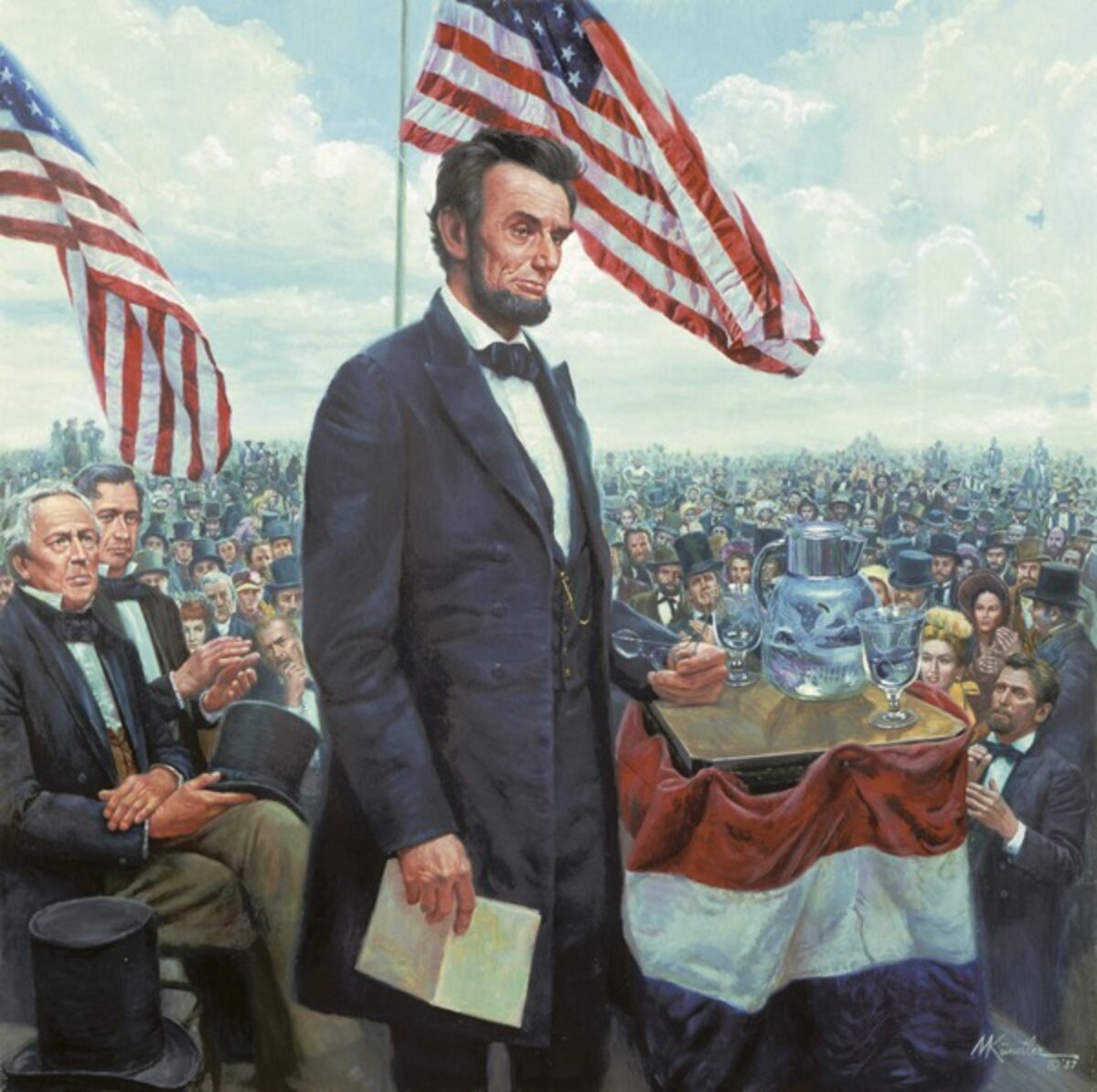
On November 19, 1863, more than 15,000 people gathered for the dedication. Everett stood before them and spoke for nearly two hours. His carefully prepared address contained more than 13,000 words.
Then Abraham Lincoln stood.
He spoke for less than three minutes.
Just 272 words.
And then he sat down.
Accounts of the crowd’s immediate reaction vary. There was applause, although Lincoln apparently worried that his remarks had not been well received. Newspaper reaction was divided as well, often along political lines.
Everett, however, understood what Lincoln had accomplished. The following day, he wrote to the President that he wished he could have come as close to the central idea of the occasion in two hours as Lincoln had in two minutes.
The Gettysburg Address became one of the defining statements of the American experiment. Generations of schoolchildren memorized it. Its words were carved into the Lincoln Memorial.
And there is a wonderful irony in all of this.
Everett spent nearly two hours addressing the crowd at Gettysburg. Today, few Americans could quote a single sentence from his speech.
Abraham Lincoln spoke 272 words.
More than 160 years later, we are still quoting them.
“…that we here highly resolve that these dead shall not have died in vain — that this nation, under God, shall have a new birth of freedom — and that government of the people, by the people, for the people, shall not perish from the earth.”
Lincoln was wrong about one thing that day.
He told the crowd, “The world will little note, nor long remember what we say here.”
The world did note it.
And more than a century and a half later, we still remember.